Furnace volume is one of the most important parameters in industrial combustion system design, but it is often misunderstood.
When selecting a burner, engineers naturally focus on heat input, fuel type, operating temperature, and burner capacity. However, the available furnace volume also determines how the flame develops, how combustion gases circulate, how heat is distributed, and how much space is available for the thermal process to occur.
A burner with the correct thermal capacity can still perform poorly if it is installed in a furnace that is too small, too large, or poorly matched to its flame characteristics.
The key principle is:
Furnace volume does not determine burner selection by itself, but it strongly influences whether a selected burner can operate effectively inside the equipment.
Furnace volume is the internal space available within the combustion or heating chamber.
For a simple rectangular chamber:
Furnace Volume = Length × Width × Height
In real industrial equipment, however, the effective combustion volume may be different from the nominal geometric volume.
Internal components can occupy space, including:
Products
Shelves
Rollers
Heat exchangers
Baffles
Refractory structures
Internal ducts
Fixtures
Therefore, engineers should distinguish between geometric furnace volume and the effective volume available for combustion and heat transfer.
A burner does not simply release heat into an empty box.
It produces a flame with specific characteristics:
Flame length
Flame diameter
Flame velocity
Flame momentum
Heat-release intensity
Combustion-gas flow
Temperature profile
The furnace must provide sufficient space for these characteristics to develop.
This creates a basic relationship:
Burner Characteristics ↔ Furnace Volume ↔ Furnace Geometry ↔ Heat Distribution
If the burner and furnace are poorly matched, several problems can occur.
No.
This is one of the most important points to understand.
Furnace volume and burner capacity are related, but they are not interchangeable.
A large furnace may require relatively low heat input if:
The product load is low
The operating temperature is moderate
The furnace is well insulated
The heating cycle is slow
The process has low thermal demand
Conversely, a relatively compact furnace may require a high-capacity burner if the process requires:
Rapid heating
High production throughput
High operating temperature
Significant moisture evaporation
High heat-transfer intensity
Therefore:
Burner capacity should be determined from thermal demand, while furnace volume should be used to evaluate flame development and heat distribution.
Flames require physical space to develop.
Consider three situations.
If the chamber is too small relative to the flame characteristics, the flame may reach:
Furnace walls
Refractory
Product
Rollers
Internal components
This can cause localized overheating or flame impingement.
The flame can develop within the available chamber space, allowing combustion gases to distribute heat more effectively.
The flame may not provide sufficient coverage of the entire thermal space.
This can result in:
Poor temperature uniformity
Localized heating
Longer heat-up times
Additional circulation requirements
The ideal solution is therefore not simply to maximize furnace volume.
Flame length determines how far the combustion process extends into the furnace.
A long flame requires adequate space.
A short, high-intensity flame requires less physical distance but may concentrate heat near the burner.
This means the following combinations can create problems:
Long flame + short furnace
→ Potential flame impingement
Short flame + large furnace
→ Potentially poor heat coverage
Appropriately sized flame + appropriately designed furnace
→ Better heat distribution
This is why burner selection should consider flame geometry rather than only burner capacity.
After combustion occurs, hot gases need to transfer energy to the furnace and the product.
The heat-transfer process depends on:
Gas circulation
Furnace geometry
Flame position
Burner angle
Exhaust location
Product position
Recirculation
Internal structures
Furnace volume determines the available space for these flows to develop.
A furnace with sufficient volume can provide greater opportunity for combustion gases to circulate before leaving through the exhaust.
However, simply increasing volume does not guarantee better heat transfer.
Poor airflow design can still create:
Hot spots
Cold zones
Temperature stratification
Uneven product heating
Not necessarily.
Volume is only one part of furnace geometry.
Two furnaces can have the same volume but completely different combustion characteristics.
For example:
Long and narrow
Burner installed at one end
Exhaust at the opposite end
Short and wide
Burner installed on the side
Exhaust located near the top
Even if both have the same internal volume, the flame and hot-gas flow can behave very differently.
Therefore, burner selection should consider:
Volume
Length
Width
Height
Burner location
Burner angle
Exhaust location
Product location
Internal obstacles
Burner location becomes particularly important when the available volume is limited.
A burner may be installed:
Horizontally
Vertically
From the side
From the top
From the bottom
At an angle
At multiple locations
The installation position determines the available flame-development distance.
For example, a burner installed at the end of a long furnace has a very different flame-development environment from a burner installed in the center of a compact chamber.
The available volume must therefore be considered together with burner position.
Burner angle changes the trajectory of the flame.
A burner may fire:
Straight ahead
Upward
Downward
Tangentially
Toward a recirculation zone
Changing the angle can alter:
Flame-wall distance
Gas circulation
Heat distribution
Product exposure
Local temperature
A compact furnace may require a carefully controlled burner angle to prevent flame impingement.
A larger furnace may provide more flexibility for developing a circulating thermal field.
Furnace volume can influence whether one burner or multiple burners are appropriate, but it does not determine burner quantity by itself.
Multiple burners may be beneficial when the furnace requires:
Multiple heating zones
Better temperature uniformity
Distributed heat input
Independent zone control
Large-area heating
For example, a long furnace may use several burners positioned along its length rather than one very large burner.
This can provide better control over the thermal profile.
However, simply adding more burners does not automatically improve performance.
Burner interaction, flame overlap, air distribution, and control strategy must also be evaluated.
One useful engineering concept is volumetric heat release rate.
It describes how much thermal power is released relative to the available furnace volume.
A simplified relationship is:
Volumetric Heat Release Rate = Burner Heat Input ÷ Furnace Volume
For example, if a furnace contains a 1 MW burner and has a nominal internal volume of 10 m³, the nominal volumetric heat release rate is:
100 kW/m³
This value can help engineers compare different furnace configurations.
However, it should not be treated as a universal burner-selection limit.
Acceptable values depend on factors such as:
Burner technology
Furnace temperature
Fuel
Flame characteristics
Combustion method
Airflow
Refractory
Heat-transfer requirements
Emission requirements
The number should therefore be interpreted within the complete combustion design.
Yes, indirectly.
Combustion stability depends on the interaction between:
Fuel
Combustion air
Burner design
Furnace pressure
Flame velocity
Recirculation
Chamber geometry
Furnace volume influences the space available for hot-gas recirculation and flame development.
If the chamber environment causes excessive disturbance, backpressure, or unfavorable flow patterns, the burner may experience unstable operation.
However, combustion stability should not be attributed to furnace volume alone.
Furnace pressure is influenced by:
Combustion-gas generation
Exhaust capacity
Air supply
Leakage
Exhaust resistance
Furnace geometry
Volume itself does not directly determine pressure.
However, furnace volume and gas-flow paths influence how combustion gases move through the equipment.
For this reason, furnace pressure should be evaluated together with the burner, combustion-air system, and exhaust system.
Not necessarily.
Combustion-air demand is primarily determined by:
Fuel flow
Fuel composition
Air-fuel ratio
Excess-air requirement
Burner operating condition
A larger furnace does not automatically consume more combustion air.
However, larger equipment may require additional process air, recirculation air, or dilution air, depending on the application.
This distinction is important:
Combustion Air ≠ Process Air
The combustion-air requirement is associated with the burner.
The process-air requirement is associated with the heating process.
Furnace volume is particularly important in industrial drying systems.
A drying chamber needs enough space for:
Heated air circulation
Moisture removal
Product exposure
Temperature distribution
Exhaust-air movement
The burner may heat process air rather than directly contacting the product.
The overall system can be represented as:
Burner → Hot Air → Drying Chamber → Product → Moist Exhaust
In this situation, chamber volume influences residence time and air circulation.
However, drying performance also depends strongly on:
Airflow
Air velocity
Product loading
Moisture content
Recirculation
Exhaust rate
Temperature
Therefore, furnace volume should never be evaluated independently from airflow design.
In heat-treatment applications, furnace volume affects how the thermal field develops around the product.
The key requirement is often not simply achieving a certain furnace temperature, but achieving:
Stable + Uniform + Controlled Heating
Important factors include:
Burner position
Flame shape
Gas circulation
Product arrangement
Recirculation
Furnace insulation
Temperature zones
A furnace with sufficient volume but poor circulation can still produce unacceptable temperature differences.
High-temperature equipment requires particular attention to flame-wall interaction.
As operating temperature increases, localized heat release can create significant thermal loads on:
Refractory
Furnace walls
Fixtures
Product
Heat-resistant components
Therefore, high-temperature furnace design should consider:
Flame length
Flame temperature
Burner angle
Burner position
Heat-release distribution
Gas circulation
A burner should not simply be selected based on the required maximum temperature.
Yes, but indirectly.
Furnace volume itself does not automatically determine fuel consumption.
Fuel consumption is influenced by:
Required process heat
Heat loss
Product load
Exhaust losses
Insulation
Air-fuel ratio
Burner efficiency
Operating temperature
Furnace pressure
A larger furnace may have greater surface area and therefore potentially greater heat loss, depending on its design.
However, two furnaces with the same volume can have very different energy consumption because of differences in insulation, operating conditions, airflow, and process load.
No.
Increasing volume may provide more space for hot gases to circulate, but it does not automatically solve temperature-uniformity problems.
Uniformity depends on the interaction between:
Burner + Flame + Airflow + Furnace Geometry + Exhaust + Product
Poorly positioned burners can create hot spots even inside a large chamber.
Conversely, a compact furnace with well-designed circulation can achieve excellent temperature uniformity.
Potential problems include:
The flame may contact the furnace wall or product.
Heat release becomes concentrated in a small region.
Repeated direct flame exposure can increase thermal stress.
Products may experience excessive local temperatures.
The chamber environment can affect flame behavior and pressure.
Burner components and furnace structures may experience excessive thermal loading.
The solution is not necessarily to reduce burner capacity.
Sometimes the correct approach is to change:
Burner type
Flame characteristics
Burner position
Burner angle
Burner quantity
Combustion method
Potential problems include:
Poor heat coverage
Slow heat-up
Temperature gradients
Local cold zones
Excessive operating time
Poor process efficiency
In this situation, engineers may consider:
Multiple burners
Different burner distribution
Hot-gas recirculation
Modified burner position
Different flame characteristics
Improved airflow
Again, the solution should address the entire thermal system rather than simply increasing burner capacity.
When requesting a burner, OEM manufacturers should provide more than a single volume number.
Ideally, provide:
Furnace length
Furnace width
Furnace height
Effective chamber volume
Burner location
Burner opening
Burner angle
Product location
Exhaust location
Internal structures
A simple cross-sectional drawing can often communicate more information than a single numerical volume.
For an existing machine, photographs are also useful.
A practical burner inquiry should include:
Internal dimensions
Volume
Operating temperature
Maximum temperature
Pressure
Refractory
Number of burners
Installation position
Installation angle
Available space
Required heat input
Fuel type
Fuel pressure
Fuel composition
Flow range
Combustion-air pressure
Airflow
Air temperature
Blower information
Exhaust flow
Exhaust temperature
Backpressure
Exhaust location
Product type
Production capacity
Heating requirements
Temperature uniformity
This information provides a much stronger basis for burner selection.
Furnace volume is considered as part of the overall combustion environment rather than as an isolated specification.
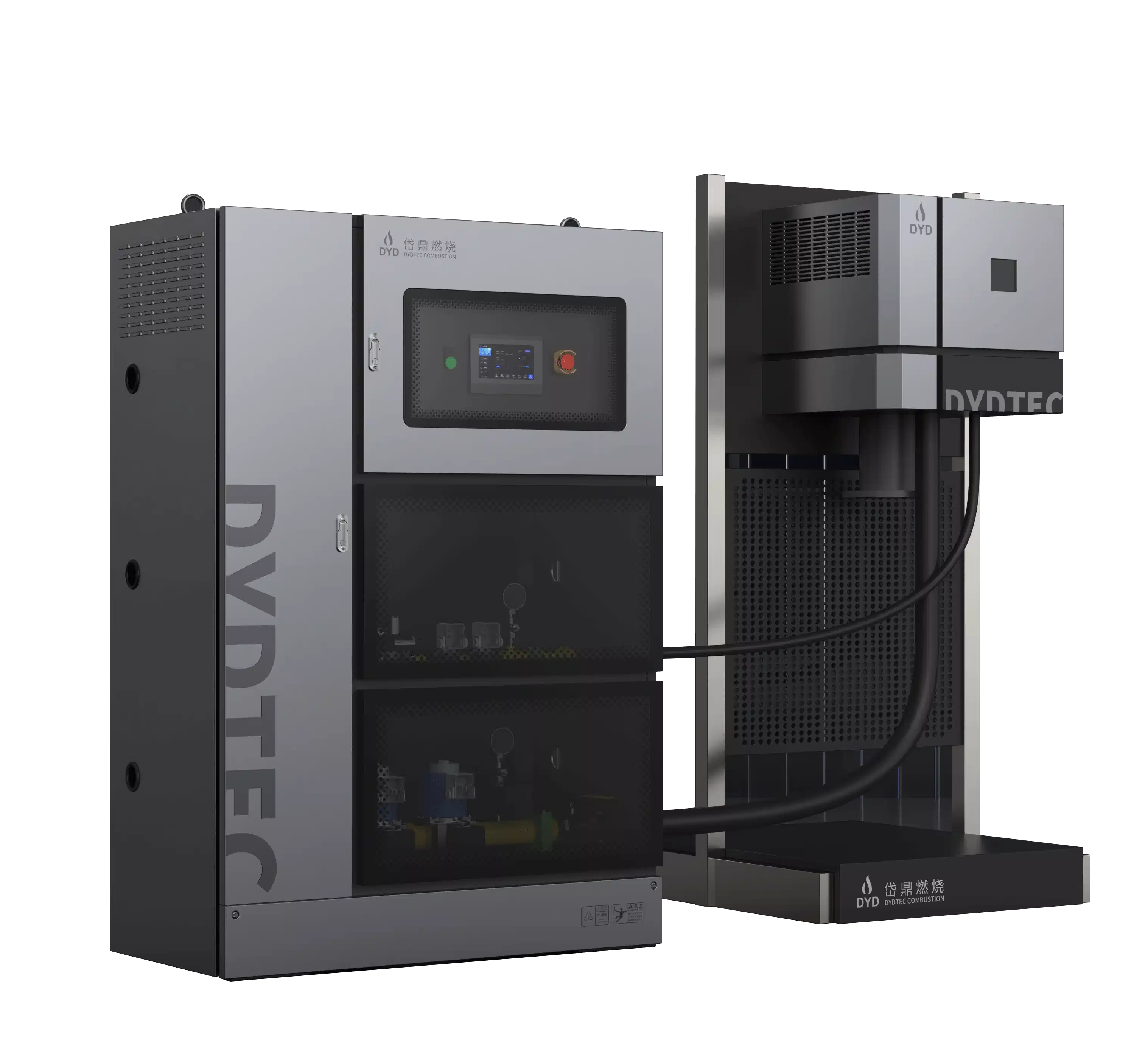
DYDTEC Combustion develops industrial burners and combustion systems for different furnace geometries and process conditions.
Its portfolio includes 100+ burner models covering 200+ application scenarios, providing different options for matching burner characteristics to equipment requirements.
For an OEM project, the evaluation can involve:
Thermal load
Furnace dimensions
Flame characteristics
Burner position
Burner angle
Fuel conditions
Air supply
Exhaust conditions
Temperature-control requirements
The objective is to achieve compatibility between the burner and the complete thermal process.
Before finalizing the chamber dimensions, engineers should ask:
What is the required heat input?
What is the minimum heat load?
What is the operating temperature?
How long should the flame be?
How wide is the flame?
Where should the flame end?
Where will the burner be installed?
Where will the product be located?
Where will the exhaust be located?
Are there internal obstacles?
How will combustion gases circulate?
Is process-air circulation required?
Is recirculation required?
How many heating zones are needed?
How much turndown is required?
How quickly must temperature respond?
Can the burner be accessed?
Can the flame detector be inspected?
Can the burner head be serviced?
These questions should ideally be addressed before the furnace structure is finalized.
No. Furnace volume describes the available internal space, while burner capacity describes thermal output. Both need to be considered during combustion-system design.
Not necessarily. Burner capacity depends primarily on thermal demand, while furnace volume affects flame development and heat distribution.
The available chamber space determines how much room the flame has to develop before reaching a wall, product, or other component.
Yes. If the flame is too large for the available space, flame impingement and localized overheating may occur.
Yes. Insufficient heat distribution can lead to slow heating and temperature gradients.
No. Burner quantity also depends on furnace geometry, thermal zoning, heat distribution, control requirements, and flame characteristics.
No. Volume alone cannot describe the combustion environment. Length, width, height, burner location, and exhaust position are also important.
Indirectly. Furnace size can influence heat loss and gas residence, but fuel consumption is primarily determined by the actual process heat requirement and system efficiency.
It can influence the combustion environment through gas circulation, recirculation, pressure, and flame development, but stability depends on the complete combustion system.
Provide the internal length, width, height, effective volume, burner position, exhaust position, product location, and a chamber drawing whenever possible.
Both matter. Volume describes the available space, while geometry determines how the flame and combustion gases actually move through that space.
Ideally, furnace dimensions and burner selection should be developed together. This allows flame characteristics, burner position, and chamber geometry to be matched from the beginning.
Furnace volume matters because a burner does not operate in isolation.
The available chamber space affects how the flame develops, how combustion gases circulate, how heat is distributed, and how the burner interacts with the furnace structure and product.
But furnace volume should never be used as a standalone burner-selection criterion.
The correct design relationship is:
Thermal Load→ Burner Capacity→ Flame Characteristics→ Furnace Volume→ Furnace Geometry→ Airflow
→ Exhaust→ Heat Distribution
The most important question is therefore not:
“How large is the furnace?”
but:
“Does the furnace provide the right thermal and physical environment for the selected burner and its flame?”
For OEM equipment, evaluating these factors together from the beginning can help prevent flame impingement, poor temperature uniformity, inefficient operation, and costly redesign.