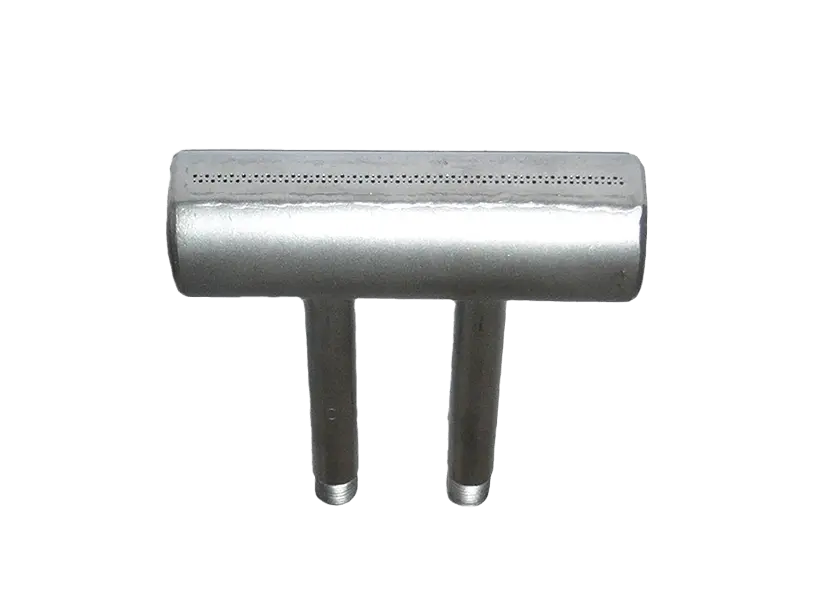
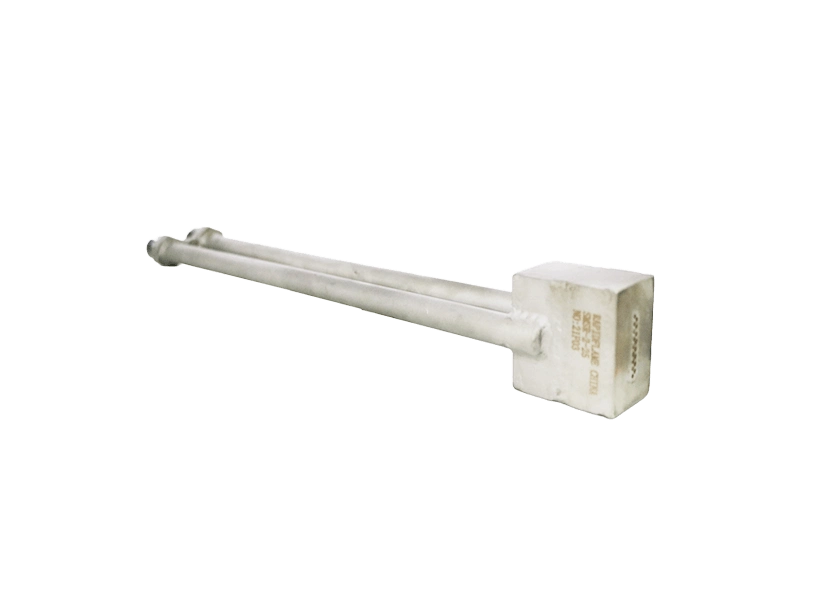
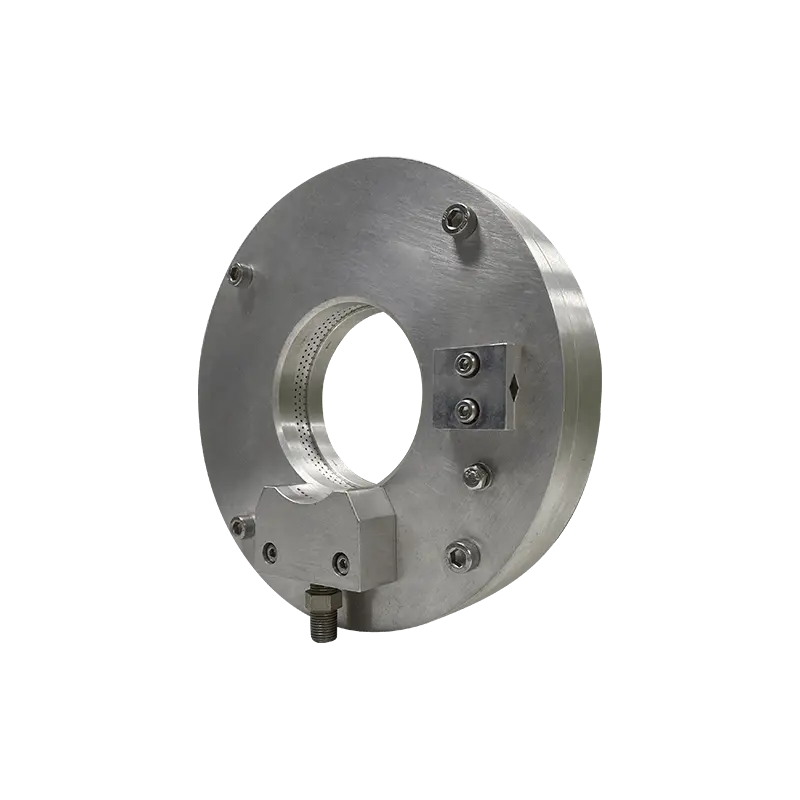
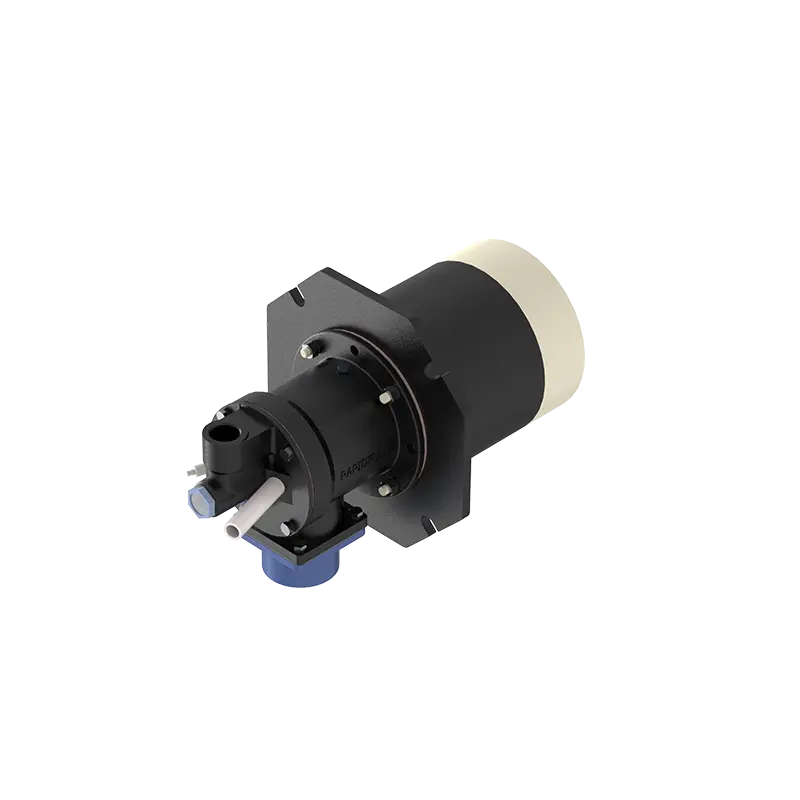
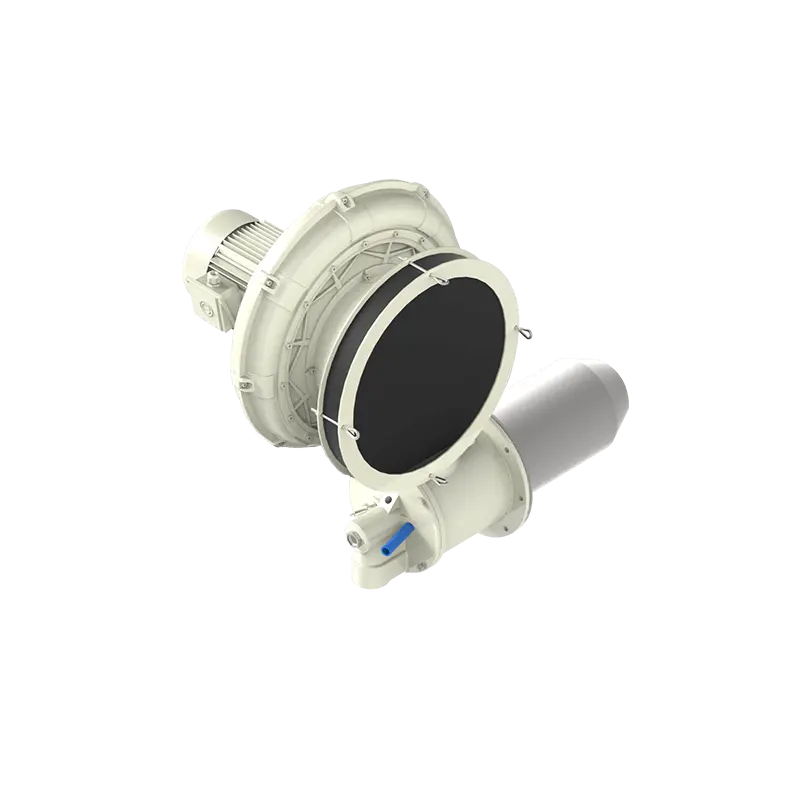
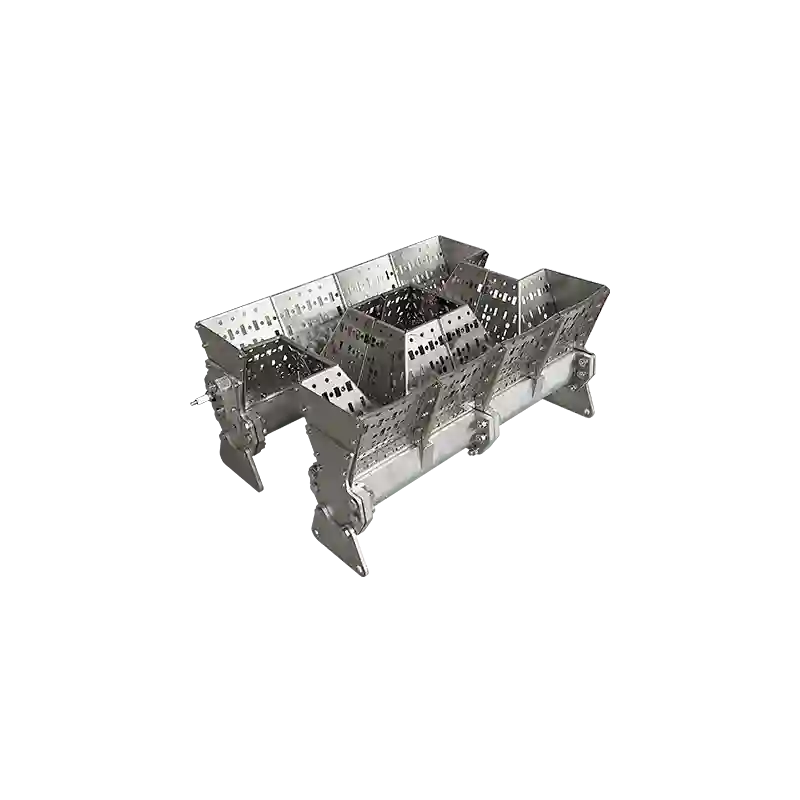
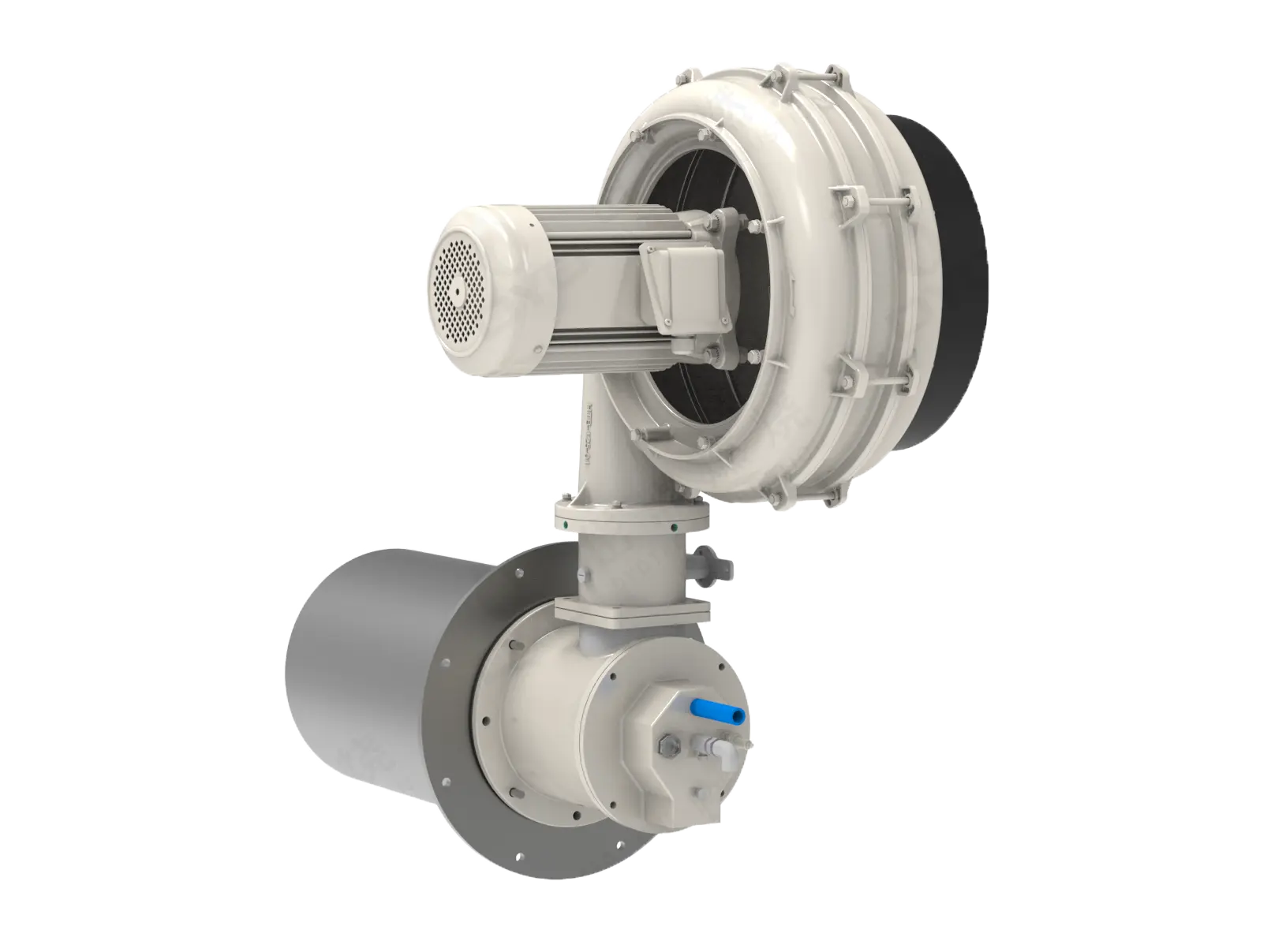
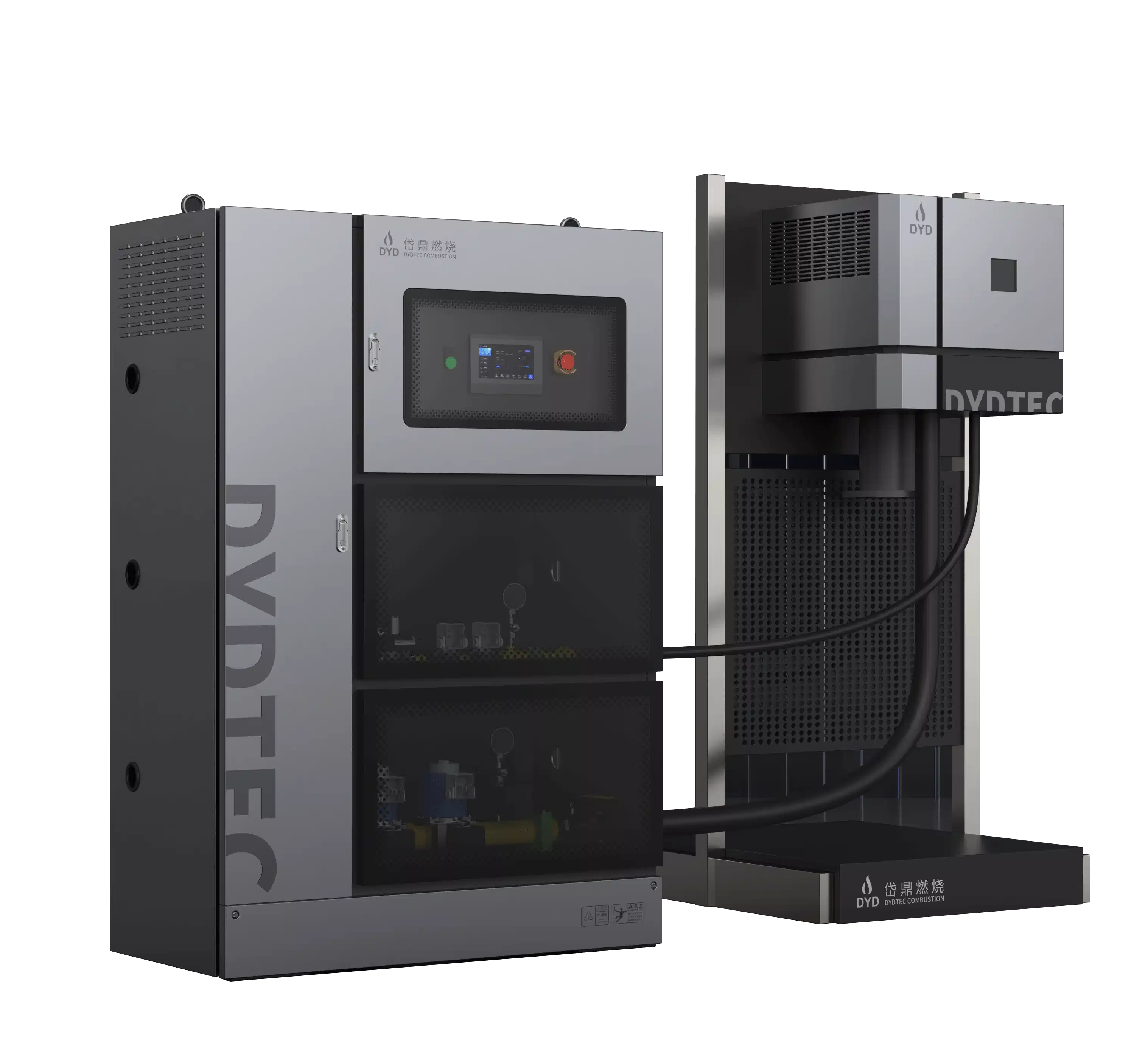
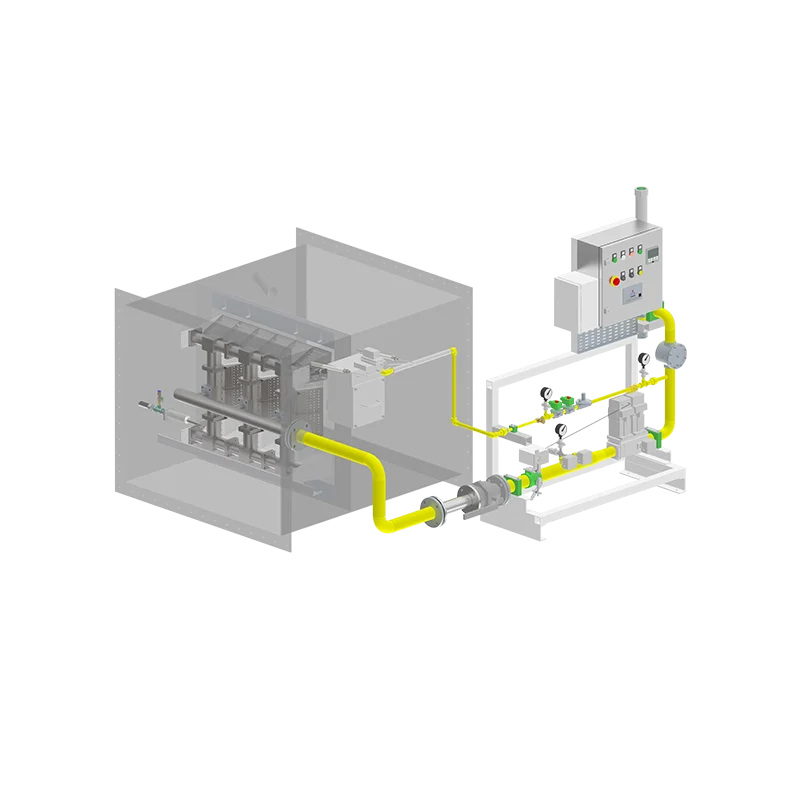
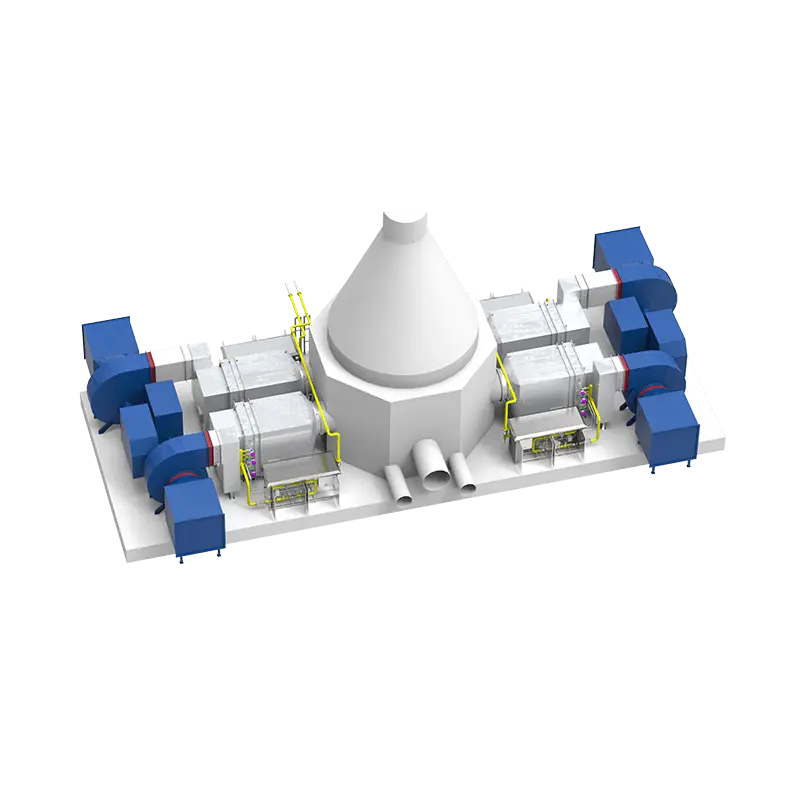
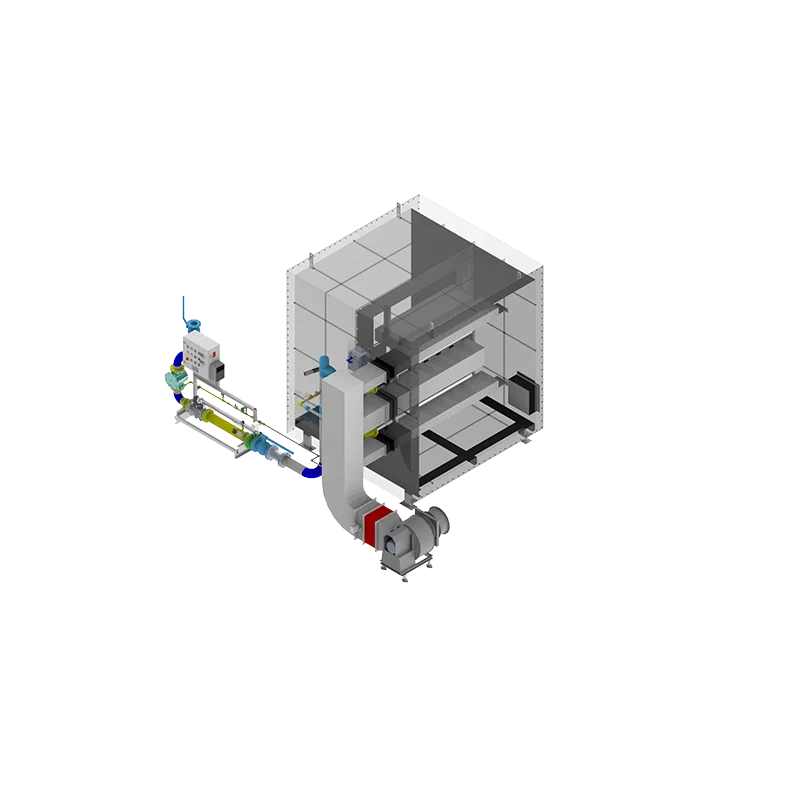
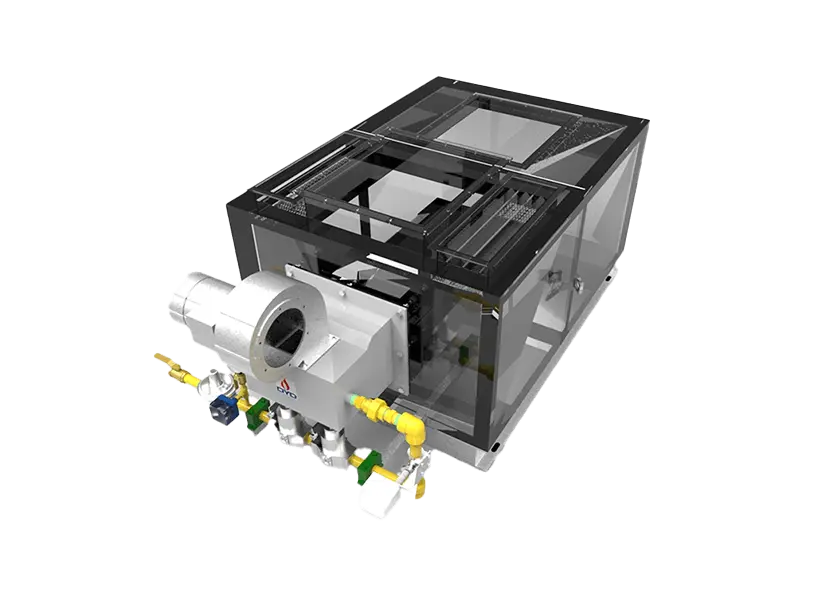
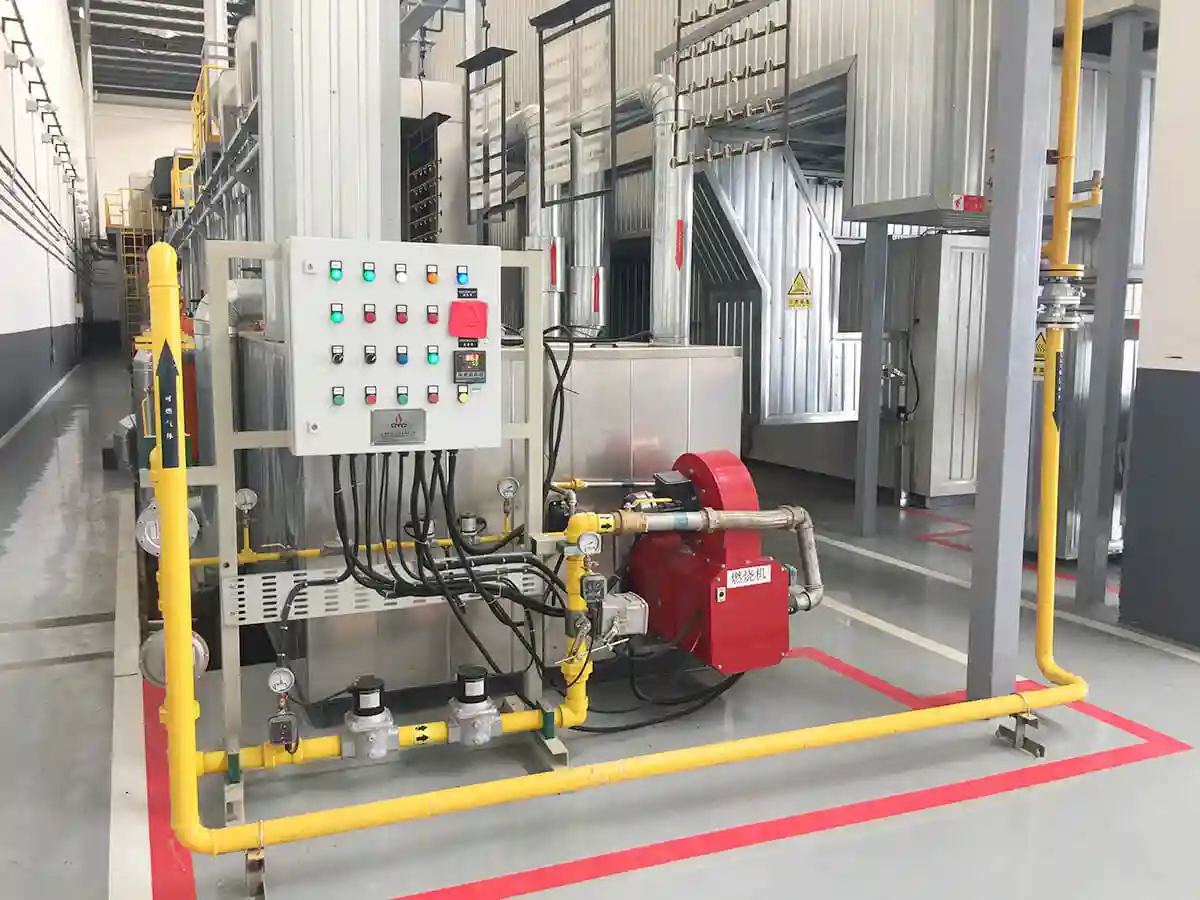
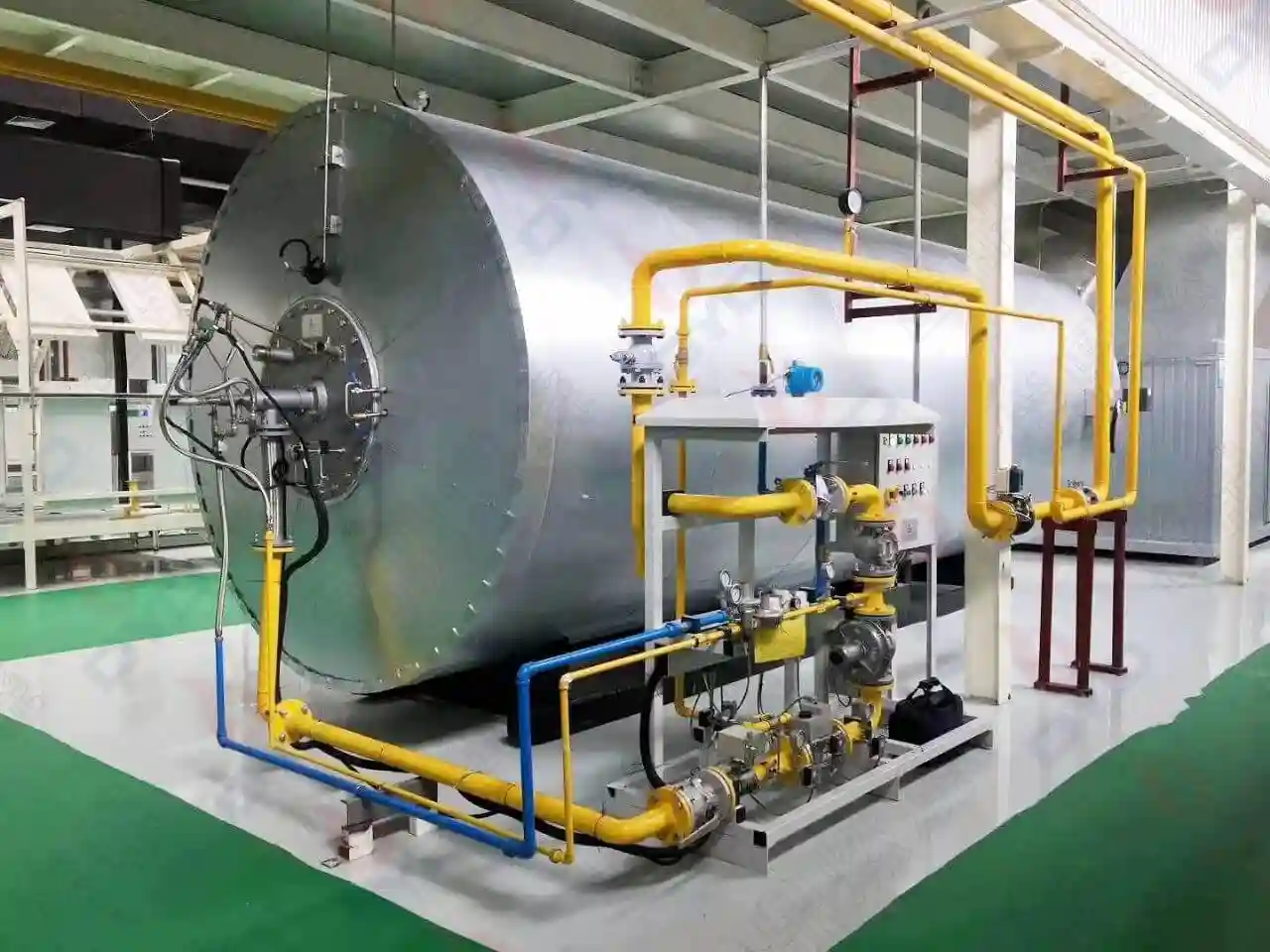
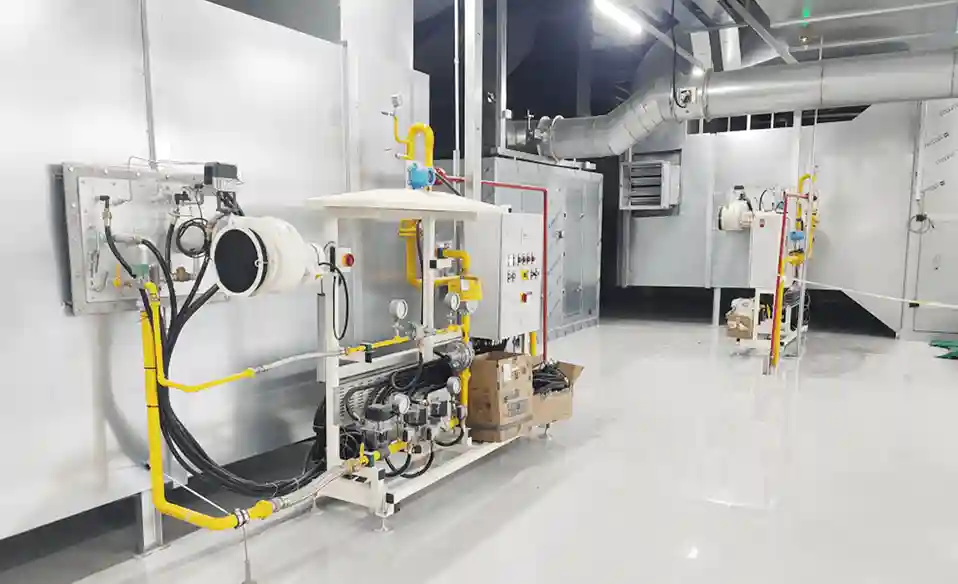
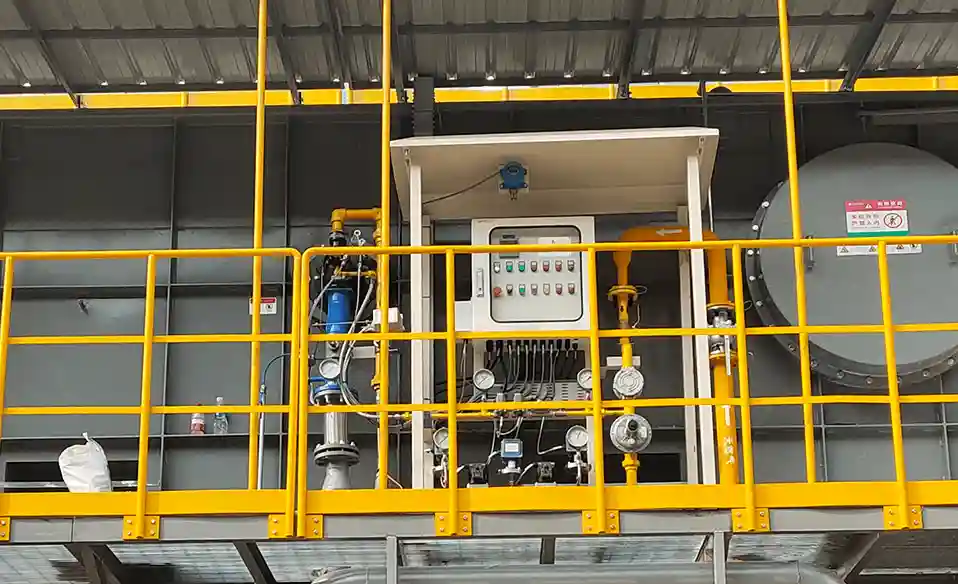
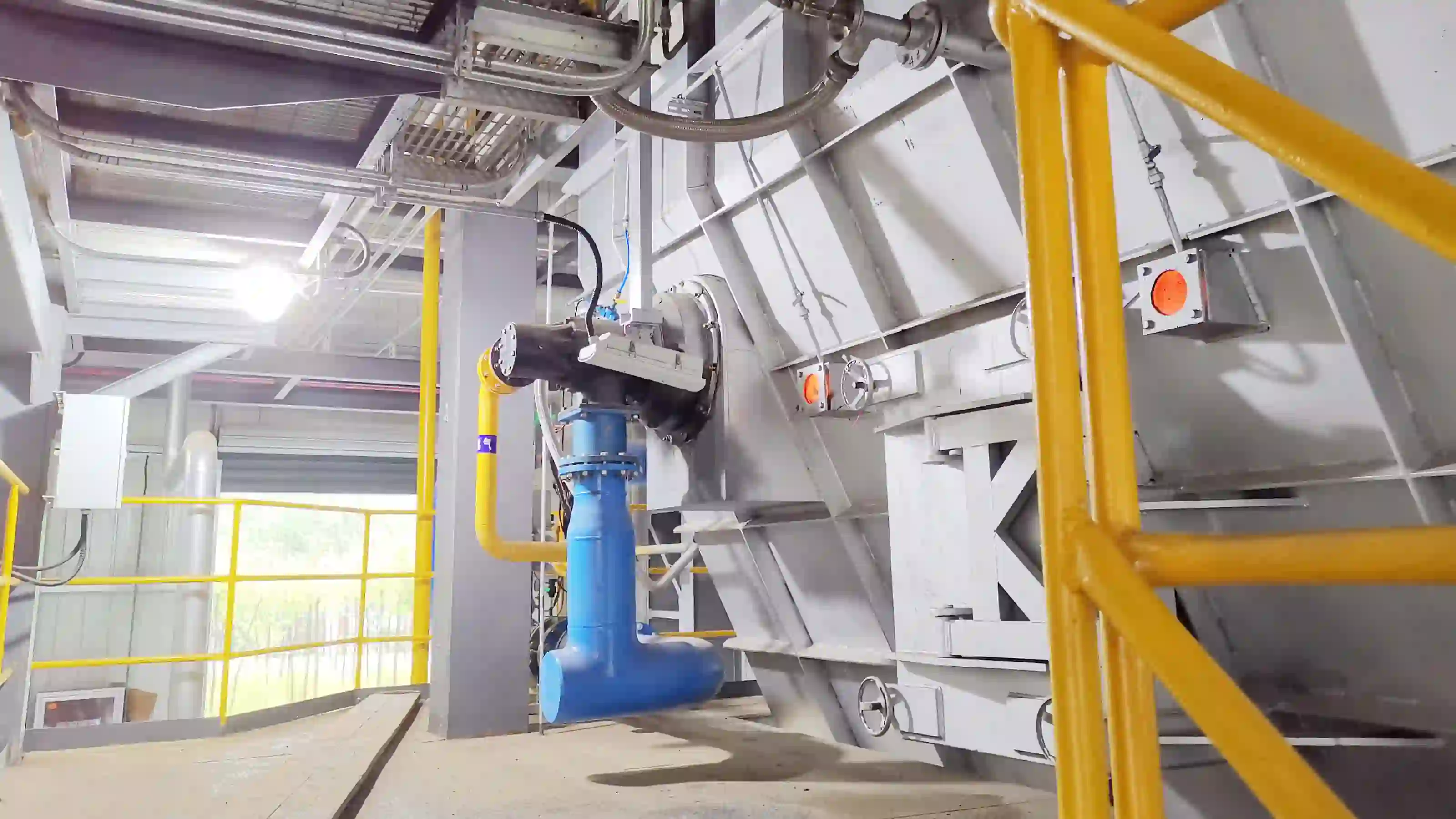
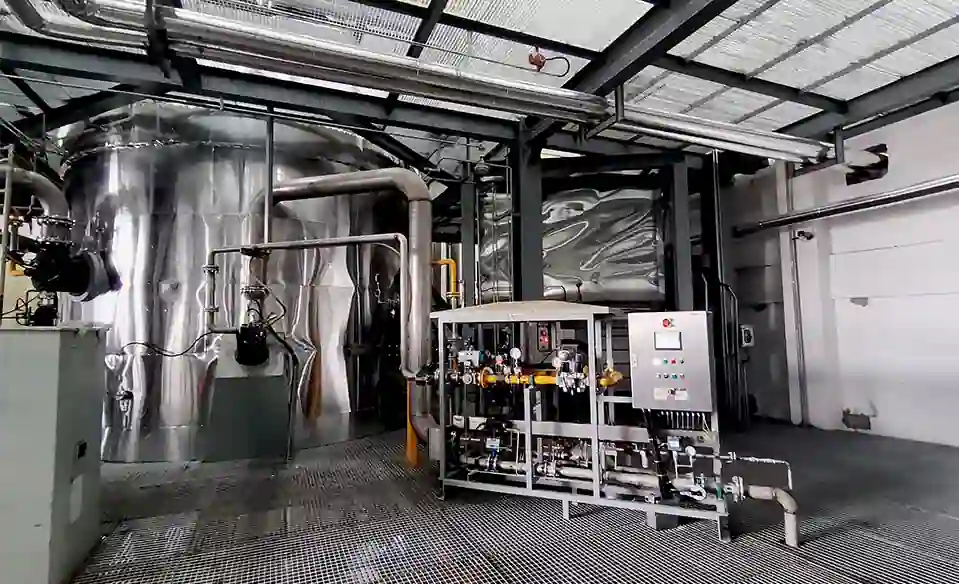
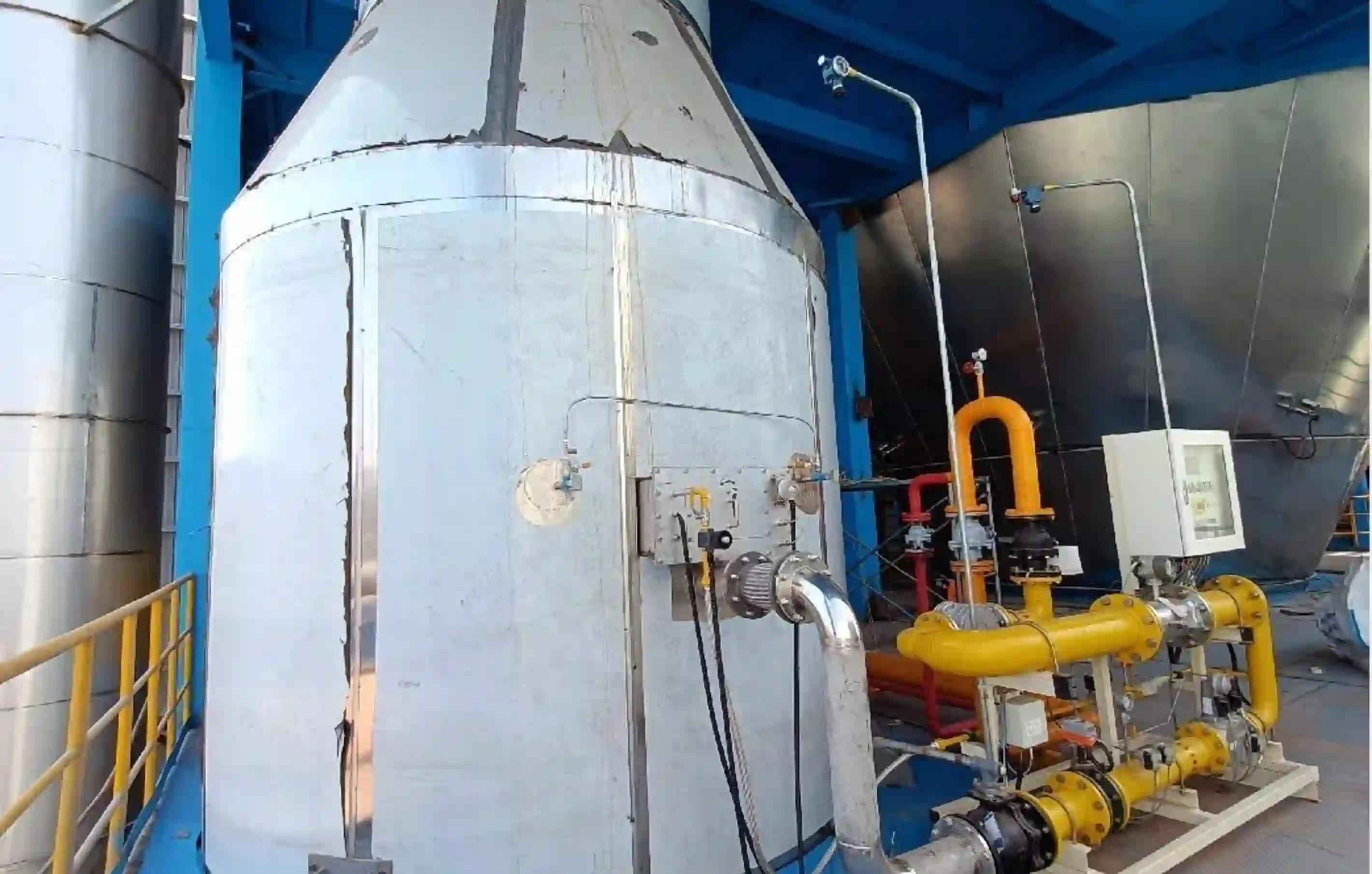
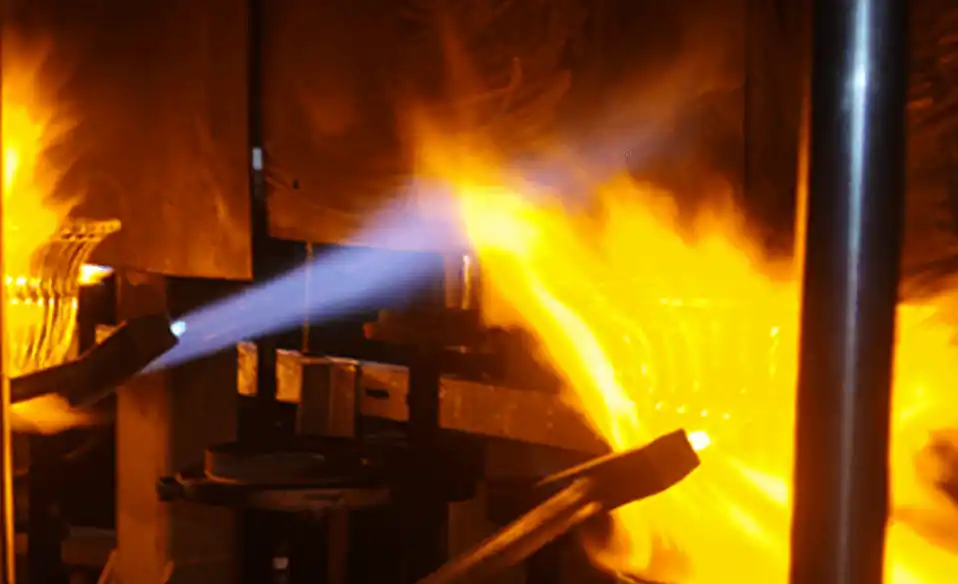
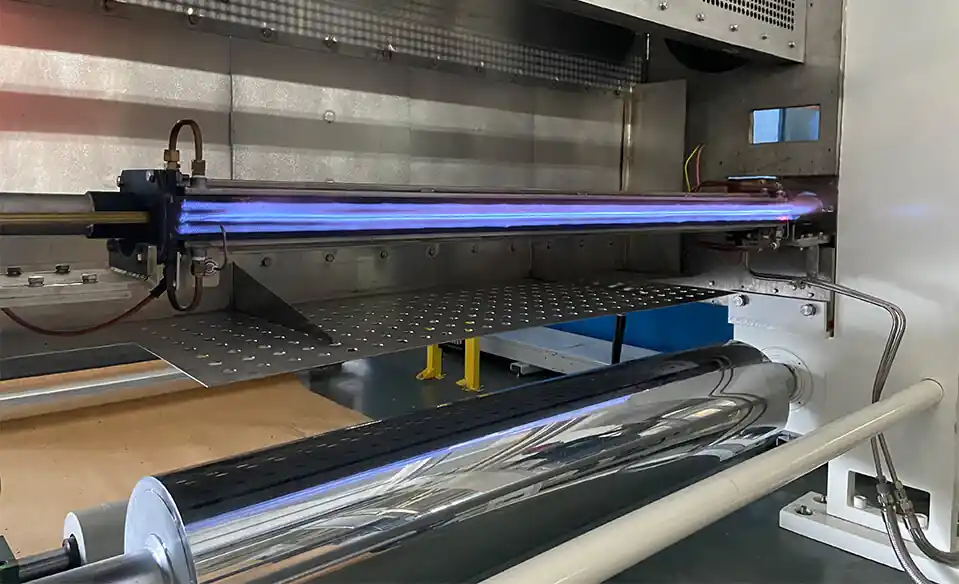
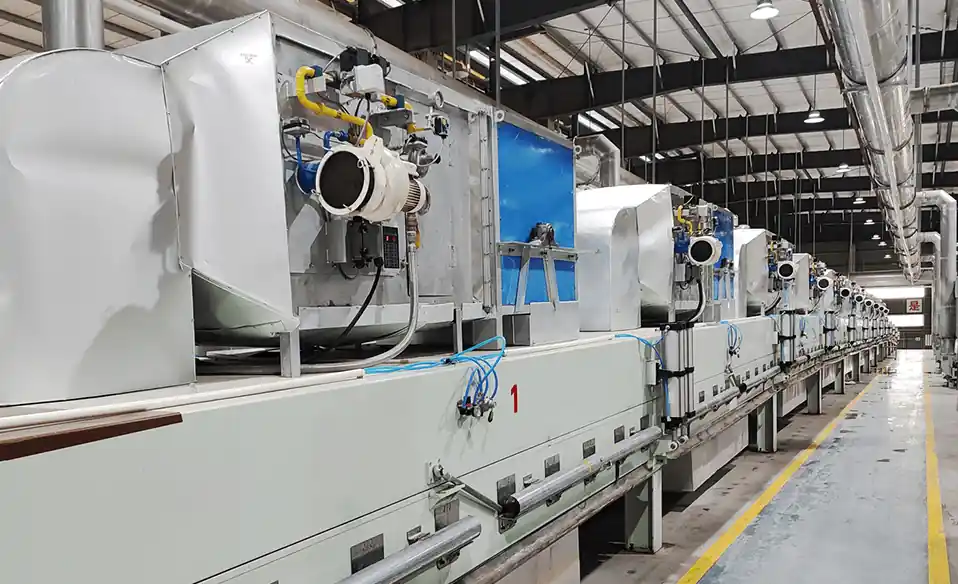
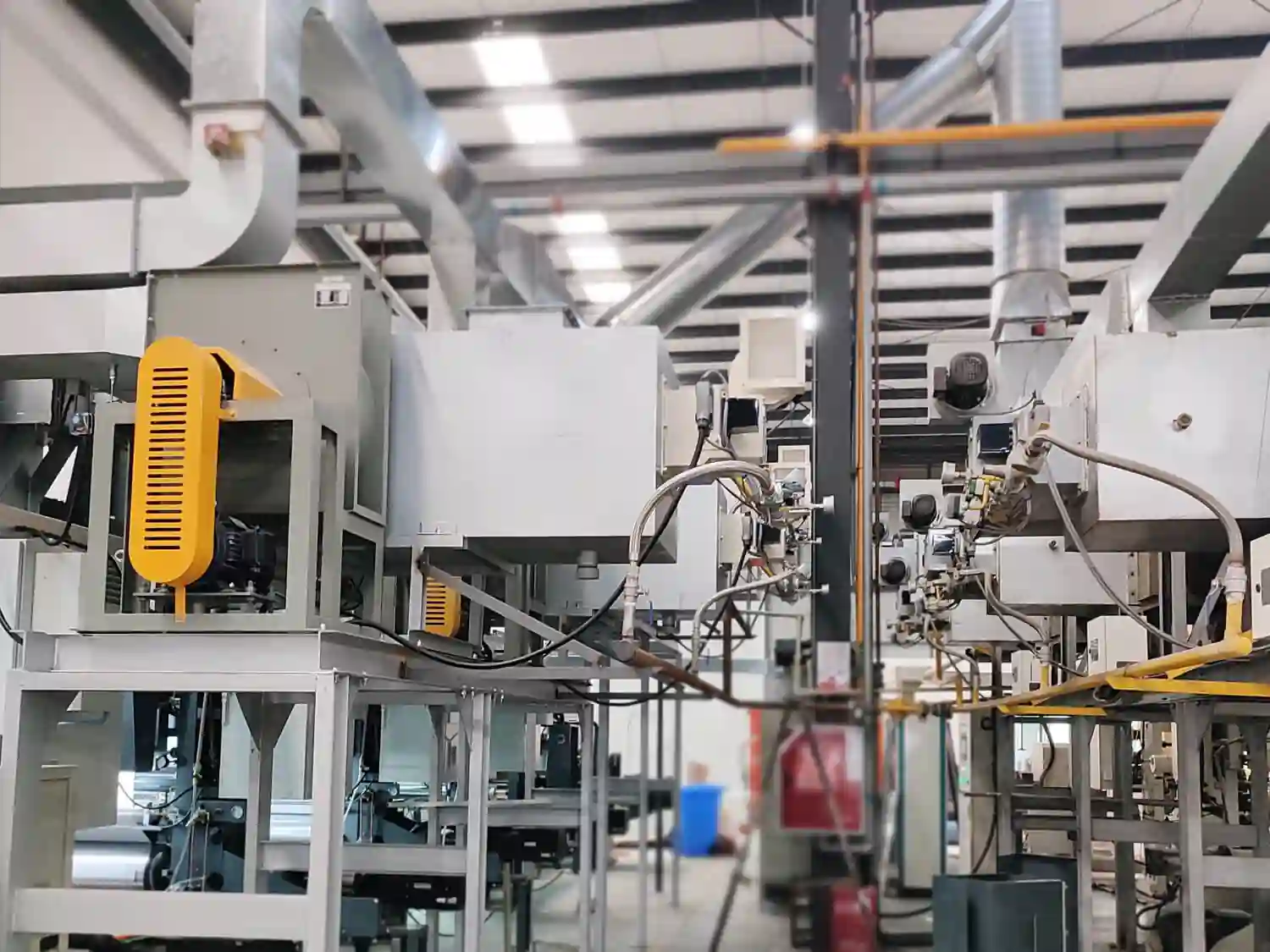
Burners are widely used in gas-fired industrial ovens to provide controlled thermal energy for heating, drying, curing, baking, preheating, and other industrial processes.
Unlike a simple heating chamber, an industrial oven must usually maintain a specific temperature range and a relatively uniform thermal environment throughout the working space. The burner therefore needs to work together with the oven chamber, circulation system, exhaust system, temperature controls, and safety system.
A typical process can be represented as:
Fuel + Combustion Air
↓
Burner
↓
Heat Generation
↓
Hot Gas Circulation
↓
Heat Transfer to Product
↓
Controlled Process Temperature
The burner is therefore only one part of the complete thermal system.
For industrial oven applications, burner selection should consider:
Oven heat load
Oven geometry
Product characteristics
Required operating temperature
Heating rate
Air circulation
Temperature uniformity
Burner capacity
Flame characteristics
Burner turndown
Exhaust conditions
Furnace pressure
Control requirements
An industrial oven is thermal-processing equipment used to heat products or materials under controlled conditions.
Industrial ovens are commonly used for:
Paint curing
Coating curing
Drying
Baking
Preheating
Heat treatment
Composite processing
Chemical processing
Food and material processing
Other industrial thermal applications
The required thermal conditions vary significantly between applications.
For example, a coating oven may require relatively uniform low-to-medium temperature air circulation, while a high-temperature industrial oven may require a substantially different burner and combustion arrangement.
The main function of the burner is to convert fuel into controlled thermal energy.
The basic process is:
Fuel
Combustion Air
↓
Ignition
↓
Stable Combustion
↓
Hot Combustion Gases
↓
Heat Transfer
↓
Product
Depending on the oven design, the burner may heat the process air directly or transfer heat indirectly through a heat exchanger.
The appropriate configuration depends on the product and process requirements.
There are two common approaches.
In a direct-fired system, combustion gases enter the oven and mix with the process air.
The heat is transferred directly from the combustion products to the oven atmosphere and product.
This configuration can provide:
Fast heat transfer
High thermal efficiency
Rapid temperature response
However, the combustion products become part of the oven atmosphere, so the process must be compatible with this arrangement.
In an indirect-fired system, combustion occurs separately from the process air.
The burner heats a heat exchanger, and the process air is heated without direct contact with combustion products.
This can be useful when the product or process requires cleaner process air.
Temperature uniformity is often one of the most important performance requirements.
The oven may have the correct average temperature while different areas have significantly different temperatures.
This can result from:
Poor burner arrangement
Inadequate air circulation
Incorrect airflow distribution
Oven geometry
Product loading
Insufficient insulation
Poor exhaust control
Uneven temperature can cause:
Inconsistent curing
Uneven drying
Product defects
Overheating
Under-processing
Longer processing cycles
The combustion system therefore needs to be designed together with the oven's air-circulation system.
In many industrial ovens, the burner generates heat while fans circulate heated air throughout the chamber.
A simplified system is:
Burner
↓
Heat Generation
↓
Circulation Fan
↓
Hot Air Distribution
↓
Product
↓
Return Air
↓
Heating Zone
The burner provides the thermal energy, while the circulation system distributes that energy.
This means a high-performance burner cannot compensate for fundamentally poor air circulation.
Airflow determines how heat reaches the product.
The airflow pattern is affected by:
Fan capacity
Duct design
Nozzle arrangement
Oven geometry
Product loading
Burner location
Exhaust location
Poor airflow can create:
Hot Zones + Cold Zones
Even if the burner is operating correctly.
For this reason, burner selection and airflow design should be coordinated rather than treated as independent systems.
Burner location determines where thermal energy enters the oven system.
Depending on the design, burners may be installed:
In a heating chamber
In a combustion chamber
Along the oven side
At the top or bottom
In multiple heating zones
The appropriate arrangement depends on the oven structure and heat-transfer method.
For direct-fired systems, flame development and combustion-gas circulation are particularly important.
For indirect-fired systems, burner location must also consider heat-exchanger design.
Burner angle can influence:
Flame trajectory
Heat distribution
Gas circulation
Local temperature
Heat-exchanger loading
Interaction with oven walls
The correct angle depends on the combustion chamber and airflow configuration.
The objective should be to establish an appropriate heat distribution pattern rather than simply direct the flame toward the product.
Flame length determines where heat is released.
A flame that is too short may concentrate heat close to the burner.
A flame that is too long may:
Reach oven walls
Impinge on equipment
Create local hot spots
Interact with other burners
The appropriate flame length depends on:
Burner capacity
Oven dimensions
Burner spacing
Fuel type
Combustion-air conditions
Flame shape affects the distribution of thermal energy.
Industrial burners can be designed to provide different flame characteristics, such as:
Long flames
Short flames
Broad flames
Narrow flames
High-momentum flames
Distributed heat-release patterns
The correct flame should match the oven geometry and heat-transfer requirements.
Oven geometry is a major factor in burner selection.
Important parameters include:
Oven length
Oven width
Oven height
Heating-zone dimensions
Product location
Burner location
Circulation path
Exhaust location
A burner suitable for a compact batch oven may not be suitable for a long continuous oven.
Burner selection should therefore begin with the actual oven configuration.
Product loading directly affects the thermal load.
Important variables include:
Product mass
Product dimensions
Initial temperature
Loading density
Product material
Production rate
Conveyor speed
A heavily loaded oven requires more thermal energy than an empty or lightly loaded oven.
Product geometry can also affect airflow and temperature distribution.
Production rate determines how much material must be heated per unit of time.
Generally:
Higher Production Rate → Higher Heat Demand
But burner capacity should also account for:
Product heating
Oven heat losses
Exhaust losses
Door-opening losses
Startup requirements
Other process losses
The burner should therefore be selected based on the complete thermal load rather than product throughput alone.
The initial temperature of the product directly affects the required heat input.
A product entering the oven at room temperature requires more thermal energy than a product that has already been preheated.
The design should therefore consider:
Initial product temperature
Product mass
Product specific heat
Required final temperature
Heating time
Production rate
Industrial ovens rarely operate at exactly the same thermal load all the time.
Heat demand changes during:
Startup
Warm-up
Normal production
Reduced production
Temperature holding
Shutdown
A burner with appropriate turndown capability can reduce heat output while maintaining stable combustion.
This can improve:
Temperature stability
Control accuracy
Fuel utilization
Low-load operation
An oversized burner may provide sufficient maximum heat but become difficult to control at low output.
Potential problems include:
Temperature overshoot
Excessive cycling
Local overheating
Poor low-load stability
Increased fuel consumption
Burner selection should therefore consider the entire operating range.
An undersized burner may not provide enough thermal energy to maintain the required process conditions.
Potential consequences include:
Slow warm-up
Longer processing time
Failure to reach the required temperature
Reduced production capacity
Poor temperature recovery after loading
Combustion air affects flame stability and thermal efficiency.
The air-to-fuel ratio influences:
Flame temperature
Combustion efficiency
Flame stability
Exhaust volume
Oxygen availability
Too much combustion air can increase exhaust heat loss.
Too little air can result in incomplete combustion.
The combustion-air system should therefore be matched to the burner and operating range.
Excess combustion air must also be heated before leaving through the exhaust.
Therefore, excessive air can increase:
Exhaust gas volume
Exhaust heat loss
Fuel consumption
However, reducing air excessively can compromise combustion.
The objective is to maintain an appropriate air-to-fuel ratio rather than simply minimize combustion air.
The exhaust system removes:
Combustion products
Moisture
Solvents
Volatile materials
Process gases
depending on the application.
The required exhaust rate is therefore determined not only by combustion but also by the process.
Excessive exhaust can remove useful heat.
Insufficient exhaust can cause:
Poor moisture removal
Excessive solvent concentration
Unstable oven conditions
Poor process control
The burner and exhaust system should therefore be designed together.
Industrial ovens may operate under controlled pressure conditions.
Excessive negative pressure can draw unwanted air into the oven through:
Doors
Seals
Openings
Conveyor entrances
This can affect:
Temperature stability
Combustion conditions
Heat loss
Process atmosphere
Appropriate pressure control is therefore part of the overall thermal-system design.
A typical control system can be represented as:
Temperature Sensor
↓
Temperature Controller
↓
Fuel / Air Adjustment
↓
Burner Output
↓
Oven Temperature
Depending on the application, the system may include:
Modulating fuel valves
Combustion-air control
Burner staging
Multi-zone temperature control
Flame detection
Safety interlocks
Fan control
Exhaust control
For long ovens, independent control of multiple zones can improve temperature distribution.
Large industrial ovens frequently use multiple heating zones.
For example:
Zone 1 → Zone 2 → Zone 3 → Zone 4
Each zone can have its own burner or heating system and temperature-control loop.
This allows the oven to establish different thermal conditions along its length.
Multi-zone control is especially useful for:
Continuous ovens
Coating ovens
Drying ovens
Curing ovens
Long conveyor systems
In a direct-fired oven, combustion gases enter the process atmosphere.
This can be highly efficient, but the process must tolerate the resulting combustion products.
For some applications, factors such as:
Oxygen concentration
Water vapor
Carbon dioxide
Combustion byproducts
may be relevant to product quality.
Where the product is sensitive to combustion gases, an indirect heating arrangement may be more appropriate.
A system-level approach is generally more effective than focusing only on burner efficiency.
Avoid unnecessary oversizing.
Distribute heat uniformly throughout the oven.
Avoid unnecessary exhaust losses.
Reduce unwanted cold-air infiltration.
Remove the required process gases without excessive heat loss.
Reduce heat loss through the oven structure.
Maintain stable operation at low heat demand.
Match heat input to the actual thermal requirements of each zone.
Maximum capacity does not determine how well the burner performs at normal operating conditions.
A burner cannot compensate for poor process-air distribution.
Flame and heat distribution must match the actual chamber.
An inappropriate flame can create localized overheating.
Product arrangement affects both heat load and airflow.
Too much air can increase exhaust losses.
Process exhaust and combustion exhaust may have different requirements.
The burner must remain stable when the oven approaches its setpoint.
The burner, fan, ducting, exhaust, controls, and oven chamber should be considered as one thermal system.
A practical selection process can follow these steps.
Determine:
Heating purpose
Target temperature
Heating rate
Processing time
Production rate
Determine:
Material
Dimensions
Weight
Initial temperature
Heat sensitivity
Loading arrangement
Consider:
Product heating
Oven heat loss
Exhaust losses
Openings
Startup requirements
Determine:
Oven dimensions
Heating zones
Product location
Burner location
Air circulation paths
Exhaust location
Decide whether the application requires:
Direct-fired heating
Indirect-fired heating
Evaluate:
Burner capacity
Turndown ratio
Flame length
Flame shape
Flame momentum
Fuel requirements
Coordinate:
Fuel supply
Combustion air
Process air
Circulation fans
Exhaust flow
Oven pressure
Coordinate:
Temperature sensors
Fuel modulation
Air control
Zone control
Flame detection
Safety interlocks
DYDTEC Combustion develops industrial burners and combustion-system solutions for industrial heating applications, including applications requiring controlled temperature, stable combustion, and uniform heat distribution.
The company has developed 100+ burner models covering 200+ application scenarios, allowing combustion configurations to be considered according to different oven structures, thermal loads, fuels, and process requirements.
For industrial ovens, burner-system design can be evaluated around:
Burner capacity
Flame length
Flame shape
Flame momentum
Burner arrangement
Burner angle
Oven geometry
Product loading
Direct or indirect heating
Combustion air
Process-air circulation
Oven pressure
Exhaust conditions
Temperature uniformity
Turndown requirements
Multi-zone control
DYDTEC Combustion was established in 2012 and has R&D and manufacturing bases in Shanghai and Yangzhou.
Its product portfolio includes industrial burners, linear burners, thermal air furnaces, and combustion-system integration, allowing the heating system to be considered beyond the burner itself.
Burner selection can affect the design of the entire oven.
It may influence:
Burner openings
Combustion chambers
Heat-exchanger design
Air circulation
Ducting
Fan selection
Exhaust arrangement
Temperature zones
Control architecture
If the burner is selected only after the oven has been designed, opportunities to optimize the complete heating system may be limited.
Early coordination allows:
Oven Geometry + Burner + Fuel + Combustion Air + Circulation + Exhaust + Control
to be considered as one integrated thermal system.
This is particularly important for OEM equipment manufacturers developing customized industrial ovens.
Before selecting a burner, an OEM should ideally provide:
Oven type
Oven length
Oven width
Oven height
Heating-zone dimensions
Burner installation locations
Exhaust locations
Insulation structure
Product material
Product dimensions
Product weight
Initial temperature
Required process temperature
Loading density
Production rate
Heating purpose
Target temperature
Heating rate
Processing time
Temperature-uniformity requirements
Atmosphere requirements
Fuel type
Fuel pressure
Fuel availability
Combustion-air pressure
Combustion-air temperature
Process-air circulation
Exhaust requirements
Desired oven pressure
This information provides the basis for determining burner capacity, heating method, flame characteristics, burner arrangement, and control strategy.
A burner provides controlled thermal energy for heating, drying, curing, baking, or other industrial processes.
Yes. In direct-fired systems, combustion gases enter the process air and transfer heat directly to the product environment.
An indirect-fired oven separates combustion from the process air, typically using a heat exchanger to transfer thermal energy.
Neither is universally better. The appropriate choice depends on the product, process atmosphere, temperature requirements, and whether combustion gases can contact the product.
Uneven temperature can cause inconsistent curing, drying, baking, or other thermal-processing results.
Burner angle influences flame trajectory, gas circulation, and heat distribution.
It allows the burner to reduce heat output while maintaining stable combustion when the oven approaches its target temperature.
Yes. Product mass, dimensions, loading density, and production rate directly influence heat demand.
The burner generates thermal energy, while airflow distributes that energy. Poor circulation can create hot and cold zones even when the burner itself is operating correctly.
Excessive combustion air can increase exhaust heat loss because the additional air must be heated before leaving the oven.
Yes. Excessive negative pressure can draw unwanted cold air into the oven and disturb temperature and process conditions.
Yes. Natural gas is commonly used when the burner and complete combustion system are designed for the required oven conditions.
Ideally, yes. Early coordination allows the burner, oven geometry, airflow, exhaust, and control system to be designed as an integrated heating system.
Burners in industrial ovens are not simply heat sources.
They are part of an integrated thermal system that determines how energy is generated, distributed, controlled, and transferred to the product.
The key factors include:
Burner Capacity
Flame Characteristics
Burner Arrangement
Oven Geometry
Product Loading
Combustion Air
Process-Air Circulation
Exhaust
Temperature Control
For industrial oven applications, the objective is not simply to reach the required oven temperature. The complete heating system must provide the right temperature, heating rate, airflow, temperature uniformity, and process conditions for the product.
For OEM manufacturers, burner selection should therefore be considered during the early stage of oven design.
The right industrial-oven burner is not simply the burner with sufficient heat capacity. It is the combustion system that matches the oven geometry, product load, heating method, airflow, exhaust, and control requirements to deliver stable and uniform thermal energy throughout the process.