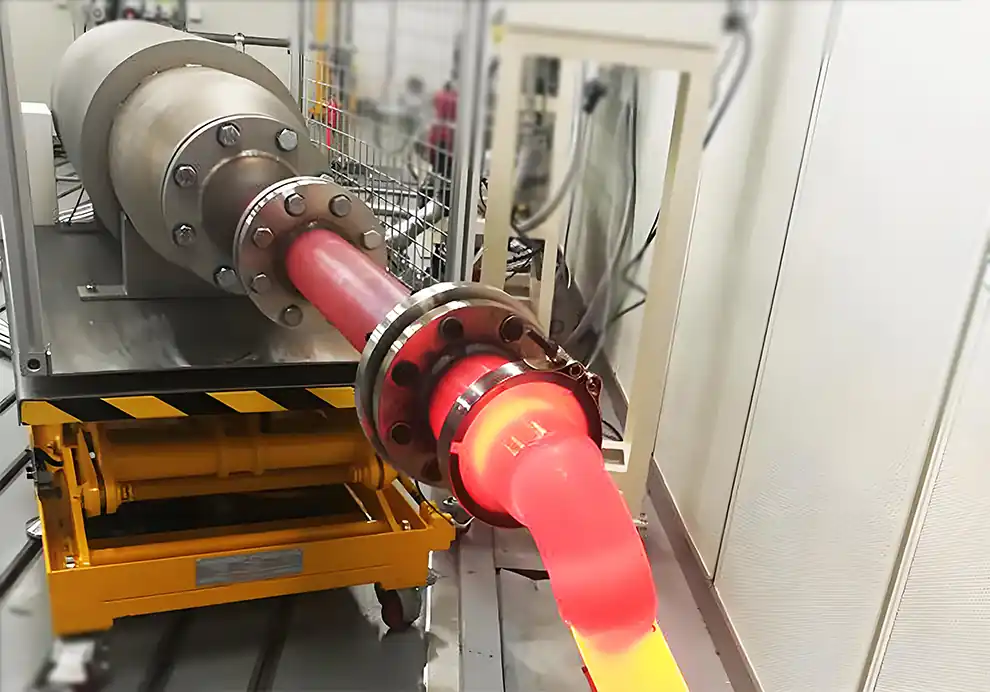
The air-to-fuel ratio (AFR) is the proportion of combustion air supplied relative to the amount of fuel entering a burner. It is one of the most critical parameters in industrial combustion because it directly affects:
Combustion efficiency – even a 1% deviation from the optimum AFR can reduce efficiency by 0.5–1%.
Fuel consumption – improper AFR is often the largest single cause of excess fuel use in industrial furnaces.
Flame stability – AFR determines whether the flame stays anchored, lifts off, or flashes back.
Furnace temperature – the flame temperature peaks near stoichiometric and drops with excess air or fuel-rich conditions.
Product quality – temperature uniformity and furnace atmosphere depend on consistent AFR control.
Equipment reliability – soot, carbon deposits, and thermal stress from unstable flames shorten component life.
Emissions (CO and NOx) – AFR has an inverse relationship with CO and a complex relationship with NOx; optimizing it is key to meeting environmental limits.
An incorrect air-to-fuel ratio can lead to incomplete combustion, excessive fuel use, unstable flames, increased maintenance, and higher operating costs. Modern industrial burners rely on precise air-fuel ratio control—often within ±1–2% of the set point—to achieve safe, efficient, and low-emission operation.
For combustion to occur, fuel must be mixed with oxygen supplied by the combustion air. The air-to-fuel ratio represents the relationship between these two inputs, typically expressed as the mass or volume of air per unit mass or volume of fuel.
For gaseous fuels, AFR is commonly expressed on a volume basis (e.g., m³ air per m³ fuel), while for liquid or solid fuels, it is expressed on a mass basis (e.g., kg air per kg fuel). The numerical value of AFR varies significantly by fuel type because different fuels contain different amounts of chemical energy and require different amounts of oxygen.
Every fuel has a theoretical (stoichiometric) air requirement, which is the exact amount of air needed for complete combustion. For natural gas, this theoretical value is approximately:
1 m³ of natural gas requires about 9.5–10 m³ of air for complete combustion.
This means the stoichiometric AFR for natural gas is roughly 9.5:1 to 10:1 by volume. For LPG (propane), the stoichiometric AFR is about 24:1 by volume (or 15.5:1 by mass) because propane contains more carbon and hydrogen per unit volume. For hydrogen, the stoichiometric AFR is only about 2.4:1 by volume due to hydrogen's very low volumetric energy density.
In real industrial applications, burners operate with slightly more air than the theoretical requirement (known as excess air) to ensure complete combustion and stable operation. Typical AFR values for natural gas burners range from 10:1 to 12:1, representing 5–20% excess air above stoichiometric.
The air-to-fuel ratio influences nearly every aspect of burner performance.
Efficient combustion requires sufficient oxygen to burn all the fuel—but not so much that unnecessary air carries heat out of the furnace. The relationship between AFR and efficiency is a classic "golden mean": too little air causes incomplete combustion (chemical losses), while too much air causes excessive stack losses (sensible heat losses).
An optimized air-to-fuel ratio provides:
Complete combustion – all fuel energy is released as heat.
Maximum heat release – the flame temperature is high enough for effective heat transfer.
Lower fuel consumption – less fuel is needed to achieve the same process temperature.
Higher thermal efficiency – the furnace operates closer to its theoretical maximum.
Even small AFR deviations can significantly affect energy costs in continuous industrial processes. For a 1 MW burner operating 8,000 hours per year, a 2% efficiency loss due to AFR error can waste approximately 160,000 kWh of energy annually—enough to power 15 average homes for a year.
A burner flame must remain stable under varying operating conditions. The AFR directly affects the flame speed, which is the rate at which the combustion wave propagates through the fuel-air mixture. If the mixture becomes too rich (excess fuel), the flame speed increases, raising the risk of flashback. If the mixture becomes too lean (excess air), the flame speed decreases, increasing the risk of lift-off.
If the mixture becomes too rich or too lean, flame problems can occur. A properly adjusted air-to-fuel ratio helps maintain:
Stable flame anchoring – the flame stays firmly attached to the burner head.
Reliable ignition – the mixture ignites consistently on every start-up.
Smooth burner modulation – the flame remains stable even as firing rate changes.
Safe operation across the firing range – from low fire to high fire without instability.
Stable flames are essential for both safety and process consistency. A flame that lifts off can cause uneven heating, while a flashback can damage the burner head and gas train.
Industrial furnaces require uniform and predictable heating. The AFR determines the adiabatic flame temperature—the theoretical maximum temperature if all heat is retained. For natural gas, the stoichiometric flame temperature is approximately 1,950–2,000°C. Adding 15% excess air lowers the flame temperature by roughly 50–80°C, which reduces radiative heat transfer.
Incorrect air-fuel ratios can cause:
Temperature fluctuations – as AFR drifts, the heat release per unit fuel changes.
Uneven heat distribution – flame shape changes with AFR, affecting where heat is released.
Longer heating cycles – lower flame temperature from too much excess air slows heating.
Reduced production efficiency – slower heating reduces throughput and increases cost per unit.
Precise combustion control helps maintain consistent furnace temperatures and improve product quality. For processes like heat treatment or glass melting, even a 5°C temperature deviation can affect product properties.
Fuel is one of the largest operating costs in industrial heating. An improperly adjusted burner may consume significantly more fuel than necessary because of:
Incomplete combustion – unburned fuel leaves as CO or hydrocarbons, representing a direct energy loss of up to 5–10% in severe cases.
Excess exhaust losses – additional air must be heated from ambient to exhaust temperature; each 1% increase in excess air reduces efficiency by 0.1–0.15%.
Frequent burner cycling – AFR instability can cause the burner to cycle more often, increasing purge losses and thermal cycling losses.
Reduced flame efficiency – a flame that is too long (fuel-rich) or too short (lean) may transfer heat less effectively.
Optimizing the air-to-fuel ratio is one of the most cost-effective ways to improve fuel economy. A well-tuned AFR control system typically reduces fuel consumption by 3–8% compared to manual or mechanical control.
The combustion process produces different emissions depending on the air-fuel ratio.
An optimized ratio helps reduce:
Carbon monoxide (CO) – CO is a direct indicator of incomplete combustion. At the correct AFR, CO is typically below 50 ppm (at 3% O₂). Even a slight fuel-rich condition can push CO above 500 ppm.
Unburned hydrocarbons (UHC) – these form when the flame is too cool or too rich; they are both a pollutant and a fuel waste.
Smoke and soot – visible emissions indicate severe incomplete combustion, usually from AFR far too low.
When combined with advanced burner technologies, proper AFR control also contributes to lower NOx emissions. While NOx is primarily temperature-driven, an AFR that is too lean or too rich can affect the thermal NOx mechanism. Modern low-NOx burners use staged AFR control (different ratios at different stages) to achieve NOx below 30 ppm while maintaining CO at acceptable levels.
Insufficient combustion air creates a fuel-rich mixture. The oxygen supply is insufficient to oxidize all the carbon and hydrogen in the fuel, so some fuel molecules only partially combust.
Common consequences include:
Incomplete combustion – some carbon remains as CO instead of CO₂.
High carbon monoxide emissions – CO can exceed 1,000 ppm.
Soot formation – carbon particles form in the fuel-rich zones.
Smoke – visible black or grey emissions from the stack.
Carbon deposits – buildup on burner heads, refractory, heat exchangers, and furnace walls.
Lower combustion efficiency – unburned fuel represents wasted energy.
Flame instability – the flame becomes longer, softer, and more prone to lift-off.
Typical symptoms include:
Yellow or orange flames (instead of clean blue)
Dirty burner heads and furnace interiors
Black or dark exhaust
High CO readings on combustion analyzers
Increased maintenance – more frequent cleaning of burner components
Fuel-rich combustion wastes energy and may create serious safety hazards. CO is toxic and can accumulate in the working environment, while unburned fuel can create explosion risks if it accumulates in the furnace.
Excess combustion air creates a lean mixture. Although combustion remains relatively clean—CO and soot are low—efficiency decreases because the extra air absorbs heat and carries it out through the exhaust.
Excess air may result in:
Lower flame temperature – more nitrogen and oxygen must be heated, reducing peak temperature.
Higher stack losses – heat is carried away by the extra gas volume; each 10% excess air can reduce efficiency by 1–1.5%.
Increased fuel consumption – more fuel is needed to compensate for heat loss.
Longer heating times – lower flame temperature slows heat transfer to the load.
Reduced thermal efficiency – the system becomes less economical per unit of product.
Higher fan energy consumption – moving more air requires more electrical power.
More air does not necessarily mean better combustion. The objective is to supply only the amount of air needed for complete combustion plus a controlled amount of excess air—typically the minimum that ensures stable operation and low CO.
The air-to-fuel ratio and excess air are closely related but not identical.
| Air-to-Fuel Ratio | Excess Air |
|---|---|
| Describes the relationship between combustion air and fuel | Describes how much additional air is supplied beyond the theoretical requirement |
| Controlled directly by burner systems | Measured indirectly using flue gas oxygen concentration |
| Determines combustion quality | Helps ensure complete combustion and operational safety |
Maintaining the correct air-to-fuel ratio automatically helps maintain the proper excess air level. For natural gas, the relationship between AFR and excess air is approximately:
| Excess Air (%) | Approximate AFR (vol/vol) for Natural Gas |
|---|---|
| 0% (stoichiometric) | 10:1 |
| 5% | 10.5:1 |
| 10% | 11:1 |
| 15% | 11.5:1 |
| 20% | 12:1 |
Thus, when engineers talk about maintaining 15% excess air, they are effectively setting the AFR at about 11.5:1 for natural gas.
Modern industrial combustion systems continuously adjust fuel and combustion air to match process demand. The control system must maintain the target AFR across the entire turndown range, from high fire down to low fire.
Common control technologies include:
Traditional burners use cams and mechanical linkages to coordinate gas valves and air dampers. As a single actuator moves, it simultaneously positions both the fuel valve and the air damper according to a predetermined cam profile. Although reliable, these systems require periodic adjustment and may lose accuracy over time due to wear in linkages, cables, or bearings. Typical accuracy is ±3–5% of set point.
Electronic systems independently regulate air and fuel using servo motors and programmable controllers. Each actuator has position feedback, and the controller maps the desired firing rate to specific air and fuel positions using a stored curve (often with multiple calibration points). Advantages include:
Higher accuracy – typically ±1–2% of set point.
Better repeatability – electronic positioning eliminates mechanical hysteresis.
Faster response – servo motors respond more quickly than mechanical linkages.
Improved efficiency – tighter ratio control reduces excess air variability.
Easier tuning – adjustments are made digitally without changing physical parts.
VFDs regulate combustion fan speed according to burner load, reducing both electrical consumption and excess air. Unlike damper-based systems that throttle airflow with pressure drop, VFDs adjust fan speed directly, providing linear airflow control. This can reduce fan energy consumption by 30–50% at low fire and improve AFR accuracy because the air supply is smoother.
Oxygen trim systems continuously measure oxygen in the flue gas and automatically adjust combustion air. These systems provide closed-loop control that compensates for:
Changes in ambient temperature and humidity (affecting air density)
Variations in fuel composition
Mechanical drift in linkages or actuators
Filter loading or damper hysteresis
Benefits include fuel savings of 1–3%, more stable combustion, lower emissions, and compensation for seasonal changes. The payback period for oxygen trim on a continuously operated furnace is typically 6–18 months.
Rather than measuring airflow alone, combustion performance is typically evaluated using a combustion analyzer. A portable or permanently installed analyzer samples flue gas and provides a real-time assessment of AFR quality.
Engineers commonly monitor:
Oxygen (O₂) – the primary indicator of excess air; typical target 2–4% for natural gas at high fire.
Carbon dioxide (CO₂) – a byproduct of complete combustion; higher CO₂ generally indicates better efficiency (max CO₂ for natural gas is ~11–12%).
Carbon monoxide (CO) – indicates incomplete combustion; should be below 50 ppm (at 3% O₂) for good performance.
Flue gas temperature – higher temperatures indicate more heat loss; the difference between flue gas and ambient is a direct measure of stack loss.
Excess air – calculated from O₂; displayed directly on most modern analyzers.
NOx emissions – monitored where environmental limits apply.
These measurements provide a comprehensive picture of combustion quality and help identify opportunities for optimization. A full combustion tune-up typically involves taking readings at several firing points (e.g., 25%, 50%, 75%, 100% load) and adjusting the ratio curve to minimize the spread between low-fire and high-fire excess air.
An improperly adjusted burner may exhibit several warning signs:
Higher-than-normal fuel consumption – the most obvious sign; fuel bills increase without production increases.
Unstable furnace temperature – the furnace struggles to maintain setpoint with overshoots and undershoots.
Frequent burner shutdowns – flame failure trips due to unstable combustion at low or high fire.
Flame pulsation or lifting – the flame moves, oscillates, or detaches from the burner.
Yellow or smoky flames – instead of a clean blue flame, the flame appears orange or emits smoke.
Carbon deposits on burner components – soot or coke buildup on burner heads, flame retention rings, or furnace walls.
High CO emissions – measured by combustion analyzer; often the earliest warning sign.
Excessive oxygen in flue gas – above 5–6% O₂ at high fire indicates too much excess air.
Increased maintenance requirements – more frequent cleaning, igniter replacement, or valve repairs.
Routine combustion testing can identify these issues before they lead to production losses. Periodic tuning—typically every 6–12 months—is recommended even for systems with electronic controls.
To maintain efficient combustion, industrial facilities should:
Perform regular combustion tuning – using a portable flue gas analyzer to check O₂ and CO at multiple firing points; adjust the ratio curve accordingly.
Inspect burners and mixing components – clean burner heads, check flame retention rings, and ensure nozzles are not blocked.
Calibrate gas valves and air dampers – verify that position feedback matches actual flow; check for mechanical wear.
Maintain combustion fans and actuators – ensure filters are clean, bearings are lubricated, and linkages are tight.
Monitor flue gas oxygen continuously – install an O₂ analyzer with a display for operators; log data to track long-term trends.
Install oxygen trim systems where appropriate – for larger or continuously operating furnaces, closed-loop control pays for itself.
Verify burner performance after fuel changes – switching from natural gas to LPG or biogas requires retuning.
Avoid unnecessary excess air during normal operation – train operators to recognize that "more air is not always safer."
Consistent maintenance helps ensure the burner continues operating at peak efficiency throughout its service life. A small investment in AFR tuning and control typically yields a return of 3–8% in fuel savings.
There is no single ideal value for every application. The optimal ratio depends on fuel type, burner design, furnace application, operating load, and emission requirements. The goal is complete combustion with the minimum safe amount of excess air. For most natural gas burners, the optimal AFR is between 10.5:1 and 11.5:1 (by volume), corresponding to 5–15% excess air. The exact value should be determined through combustion tuning using flue gas analysis.
Not necessarily. A fuel-rich mixture often causes incomplete combustion, reducing the amount of useful heat released and increasing carbon monoxide formation. While the flame may appear larger, the actual heat release per unit of fuel is lower because not all fuel is oxidized. The maximum heat release occurs at or slightly above the stoichiometric AFR, where combustion is complete and flame temperature is highest.
Yes. Excess air absorbs heat and carries it out of the exhaust, increasing fuel consumption and reducing thermal efficiency. For each 1% increase in excess air above the optimum, combustion efficiency drops by approximately 0.1–0.15%. In a continuously operating furnace, even a 2% efficiency loss can add thousands of dollars to annual fuel costs. Reducing excess air from 20% to 10% can improve combustion efficiency by 1–1.5%.
It should be verified during burner commissioning, scheduled maintenance (typically annual or bi-annual), after combustion system modifications, after fuel changes, or whenever abnormal fuel consumption or unstable combustion is observed. For facilities with oxygen trim systems, continuous monitoring provides real-time assurance, but periodic calibration and backup checks with a portable analyzer are still recommended.
Yes. A properly adjusted air-to-fuel ratio reduces overheating, carbon buildup, flame instability, and thermal stress, helping extend the life of burner components and combustion equipment. Incorrect AFR can cause soot buildup that insulates surfaces and causes localized overheating, or thermal cycling from instability that cracks refractory and fatigues metal parts. Regular AFR tuning is a cost-effective way to protect equipment investment and reduce unplanned downtime.
The air-to-fuel ratio is one of the most important parameters in industrial combustion. It determines how efficiently fuel burns, how stable the flame remains, and how effectively heat is transferred to the process.
Maintaining the correct ratio delivers numerous benefits, including:
Higher combustion efficiency – more heat from the same fuel.
Lower fuel consumption – reduced operating costs and carbon footprint.
Stable furnace temperatures – better process control and product quality.
Reduced emissions – meeting environmental limits and protecting worker health.
Improved product quality – consistent thermal processing leads to uniform properties.
Longer equipment life – less thermal stress and carbon damage.
Lower maintenance costs – fewer breakdowns and longer component life.
Modern combustion systems combine advanced burner design, electronic ratio control, oxygen monitoring, and intelligent automation to maintain the optimum air-to-fuel ratio across the entire operating range. For industrial users seeking greater efficiency and reliability, precise AFR control is not just a performance feature—it is a fundamental requirement for sustainable, cost-effective operation.
DYDTEC Combustion is a professional manufacturer of industrial combustion systems and high-performance burner solutions. The company specializes in low-NOx gas burners, intelligent combustion control systems, burner management solutions, and customized heating technologies for industrial furnaces, aluminum melting, heat treatment, drying equipment, RTO systems, and other thermal processing applications. By integrating advanced burner engineering with precise air-fuel ratio control, DYDTEC helps furnace manufacturers and industrial users improve combustion efficiency, reduce fuel consumption, lower emissions, and achieve reliable, long-term process performance.