An oversized burner can create serious problems in industrial heating systems, even when it appears to provide more than enough heating capacity. Many users assume that selecting a larger burner ensures faster heating and better performance—a seemingly logical but often flawed assumption. However, an incorrectly sized burner may reduce efficiency, increase fuel consumption, damage equipment, and make temperature control more difficult. The apparent advantage of extra capacity is frequently outweighed by the operational penalties that arise from operating a burner outside its optimal design range.
The correct burner should match the actual heat demand of the furnace or thermal process. The burner is designed to operate most efficiently within a specific firing range, and when forced to operate consistently below that range, its performance degrades in multiple ways.
An oversized burner may cause:
Frequent start-stop cycling, as the burner rapidly satisfies the heat demand and then shuts down.
Poor temperature stability, with overshoot and oscillation around the setpoint.
Excess fuel consumption, from reduced efficiency at low fire and cycling losses.
Increased emissions, resulting from incomplete combustion and temperature excursions.
Furnace lining damage, from localized overheating or thermal shock.
Uneven heating, with hot spots near the burner and cold zones elsewhere.
Reduced equipment life, from thermal stress and accelerated component wear.
The objective of burner selection is not maximum power, but optimal operation across the entire working range. A burner should be sized to deliver the required heat at the normal operating point while maintaining stable, efficient combustion across the expected load variations.
A burner is considered oversized when its maximum heat output is significantly higher than the actual heat demand of the furnace or process. The ratio between installed capacity and actual demand is the key indicator of oversizing.
For example:
A furnace requires 1 MW heat input for its normal operation, but a 3 MW burner is installed. Although the burner can easily reach the required temperature and has ample reserve capacity, it may not operate efficiently because it spends most of its time at very low load or cycling on and off. The burner's design operating range—typically between 30% and 100% of maximum capacity for standard burners—is not being utilized effectively.
Several common reasons lead to oversizing, often driven by well-intentioned but misguided engineering judgments.
Designers may add excessive capacity because they want to avoid insufficient heating and the associated production risks. A reasonable margin—typically 10% to 20%—can be useful to accommodate normal variations, but excessive oversizing causes operational problems that outweigh the perceived safety benefit. The fear of being "too small" frequently leads to the mistake of being "too large."
Some users select larger burners expecting increased production, larger material loads, or future process changes. The logic is to "buy capacity now" rather than upgrade later. However, if expansion never occurs or is delayed, the oversized burner operates inefficiently for an extended period, incurring unnecessary operating costs throughout its service life.
Some users assume a larger furnace automatically requires a proportionally larger burner. However, actual heat demand depends on material load, temperature requirements, heating speed, heat losses, and process cycle. Two furnaces of identical size can have very different heat demands based on their insulation quality, production rate, and operating temperature.
One of the most common problems with oversized burners is frequent ON/OFF operation. This occurs when the burner's minimum stable firing rate exceeds the furnace's steady-state heat demand.
The burner produces heat faster than the furnace can absorb it. The temperature rises quickly to the setpoint, the burner shuts down, the temperature gradually drops due to heat losses, and the burner restarts. This cycle repeats continuously, often many times per hour.
Every startup requires ignition energy, purging air, and stabilization time before the burner reaches its efficient operating point. Frequent cycling increases energy losses because each start-up sequence consumes fuel that does not contribute to the heating process.
Repeated cycling accelerates wear of ignition electrodes, gas valves, relays, flame detectors, and other components. The thermal cycling also stresses the furnace structure, leading to cracking of refractory and fatigue of metal components.
Instead of maintaining a stable temperature, the furnace experiences temperature overshoot when the burner fires and temperature droop when it is off. This oscillation makes precise process control difficult and can affect product quality.
Industrial processes rarely operate at maximum capacity all the time. A correctly sized burner can adjust smoothly with demand while maintaining efficient combustion. An oversized burner may operate below its ideal range for extended periods.
Example:
Required heat demand: 300 kW
Installed burner: 1500 kW
The burner may need to operate at only 20% capacity, where combustion stability and efficiency are significantly degraded.
Possible results:
Poor combustion stability, with flame oscillation or lift-off.
Lower efficiency, as excess air increases heat losses.
Higher CO emissions, from incomplete combustion at low firing rates.
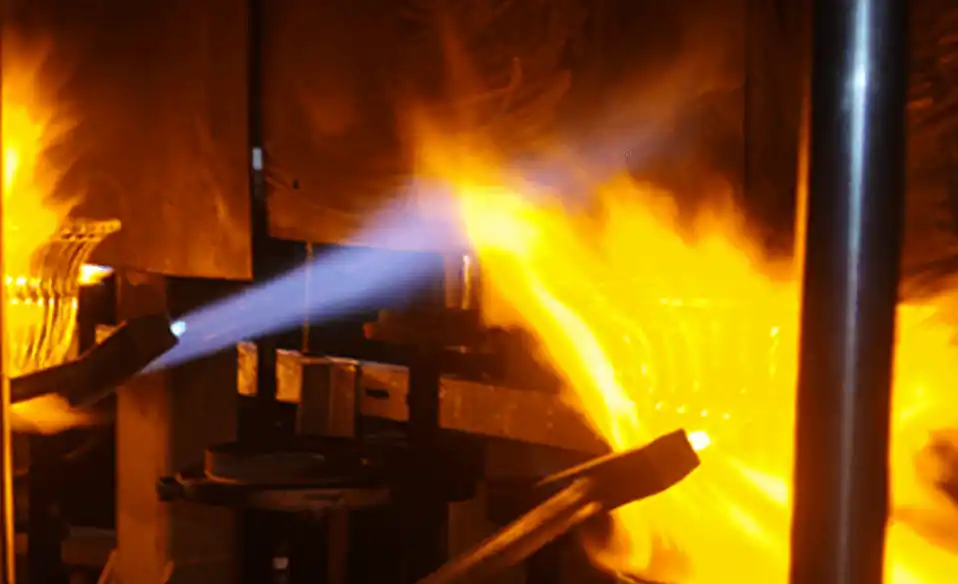
An oversized burner often produces excessive flame intensity. The flame is larger, hotter, and more concentrated than required for the furnace chamber. This may create local overheating, hot spots, and uneven temperature distribution.
Possible effects:
Surface overheating, leading to scale formation or surface degradation.
Material deformation, from differential thermal expansion.
Quality inconsistency, with some parts over-heated and others under-heated.
Possible effects:
Increased oxidation at the melt surface.
More dross formation, reducing metal yield.
Metal loss, from excessive turbulence and oxidation.
Possible effects:
Product defects, from uneven firing and differential thermal expansion.
Uneven firing, with some products over-fired and others under-fired.
Refractory damage, from localized high-temperature exposure.
High-capacity burners usually have stronger combustion jets with higher gas velocities. If the burner is too large for the furnace, excessive flame momentum may occur.
Possible consequences:
Flame impingement on furnace walls, concentrating heat on structural surfaces.
Increased refractory wear, from thermal stress and gas scouring.
Poor heat distribution, with excessive circulation in some areas and insufficient circulation in others.
Disturbance of molten materials, creating waves and entraining oxides.
The flame must match the furnace geometry, chamber volume, and heat transfer requirements. Momentum that is appropriate for a large furnace may be excessive for a smaller one.
Many people assume that a larger burner provides faster heating and therefore lower fuel consumption. This is not always true. An oversized burner may increase fuel consumption because of poor combustion control, excess air operation, frequent cycling, and higher exhaust losses.
Fuel efficiency depends on proper sizing, air-fuel ratio control, heat transfer efficiency, and operating range. A burner operating outside its optimal design range cannot achieve its rated efficiency.
Oversized burners may increase emissions in multiple ways, creating environmental compliance risks.
Potential issues:
Excessive flame temperature can increase thermal NOx formation. The larger flame creates a larger high-temperature zone, providing more residence time for nitrogen-oxygen reactions.
Poor low-load operation may create incomplete combustion. At low firing rates, the mixing of fuel and air may be less effective, resulting in localized fuel-rich zones that produce CO.
Higher firing rates may increase exhaust temperature and heat loss. Even when the burner is cycling, each firing cycle produces a transient period of high exhaust losses.
Excessive burner capacity can shorten equipment life through multiple mechanisms.
Potential damage includes:
Caused by excessive flame temperature, direct flame contact, and thermal cycling. Refractory materials are designed for specific temperature limits and thermal gradients; exceeding these limits accelerates degradation.
For hot air systems, higher thermal stress and faster material degradation occur when the burner produces more heat than the heat exchanger can efficiently transfer.
Incorrect flame positioning may damage burner blocks and furnace openings. The flame may be too close to the mounting surface, causing localized overheating.
Common signs that indicate a burner may be oversized:
✅ Burner frequently starts and stops, cycling more than a few times per hour.
✅ Temperature fluctuates significantly around the setpoint.
✅ Burner rarely operates above minimum load in normal production.
✅ Flame appears too aggressive or too large for the furnace chamber.
✅ Furnace heats too quickly near the burner area while other areas remain cold.
✅ Uneven product quality, with variations that correlate with burner cycling.
✅ Hot spots inside furnace, visible on the load or refractory.
✅ Increased oxidation, scale formation, or dross generation.
✅ Higher fuel consumption than expected for the production rate.
Several solutions are possible depending on the severity of the oversizing and the specific furnace configuration.
Improve modulation control, air-fuel ratio adjustment, and control logic. A better control system may allow the burner to operate more stably at lower firing rates. However, this is limited by the burner's inherent turndown capability.
A burner with a wider operating range can better match variable heat demand. For example, a 10:1 turndown burner can operate effectively from 10% to 100% capacity, whereas a standard burner may only achieve 3:1 or 5:1.
In severe cases, replacing the burner may provide better efficiency, improved temperature control, and lower maintenance. This is the most definitive solution but involves the highest capital expenditure.
Instead of one oversized burner, consider multiple smaller burners. For example, one 2 MW burner can be replaced by two 1 MW burners.
Advantages:
Better load adjustment, with the ability to fire one or both burners.
Improved heat distribution, with heat released from multiple points.
Higher flexibility, with zone-level control and redundancy.
A proper burner selection should consider multiple factors rather than simply maximizing capacity.
Include product heating, moisture evaporation, melting energy, and heat losses. The heat load calculation should be based on actual process conditions, not worst-case estimates.
Consider minimum load, normal operating load, and maximum load. The burner should operate efficiently at the normal working point, which should be within the burner's optimal efficiency range—typically between 30% and 80% of maximum capacity.
Include furnace size, insulation, heat distribution, and exhaust system. The burner's flame characteristics must be compatible with the furnace geometry.
Consider temperature accuracy, load changes, and production flexibility. The burner's turndown ratio should match the expected load variation.
| Item | Oversized Burner | Correctly Sized Burner |
|---|---|---|
| Initial heating speed | Fast | Appropriate |
| Temperature stability | Poor | Good |
| Fuel efficiency | Lower | Higher |
| Cycling frequency | High | Low |
| Emissions | Higher risk | Better controlled |
| Equipment life | Shorter | Longer |
| Maintenance | More frequent | Reduced |
No. A burner must match the actual heat demand. Oversizing can reduce efficiency and control performance. The correct capacity, not the maximum capacity, provides the best overall performance.
Yes. Frequent cycling, poor low-load operation, and higher heat losses can increase fuel consumption. The inefficiencies of oversizing often outweigh any perceived advantages.
A reasonable design margin may be needed, but excessive oversizing should be avoided. The appropriate margin depends on process conditions, typically in the range of 10% to 20% above calculated heat demand, not 200% or more.
Sometimes. Adjusting control systems or improving modulation range may help, but severe oversizing may require replacement. The feasibility depends on the burner's turndown capability and control system flexibility.
It can be if flame characteristics do not match the furnace. Excessive flame intensity may damage refractory, create overheating, or affect product quality. In extreme cases, flame impingement can cause structural failure.
An oversized burner does not automatically provide better heating performance. In many industrial applications, the wrong burner capacity can reduce efficiency, increase operating costs, and damage equipment. The assumption that more capacity is always better is one of the most common and costly mistakes in combustion system design.
The correct burner should provide:
Enough heat capacity to meet the maximum demand.
Stable operation across the required firing range.
Proper flame characteristics for the furnace geometry.
Efficient fuel utilization at the normal operating point.
Reliable temperature control without excessive cycling.
A well-sized burner helps industrial users achieve:
Lower energy consumption, reducing operating costs.
Better product quality, with consistent thermal treatment.
Reduced emissions, supporting environmental compliance.
Longer furnace life, minimizing capital replacement costs.
More stable production, with fewer interruptions.
The best burner is not the biggest burner—it is the burner that matches the process. Selecting a burner based on actual heat demand, operating range, and furnace characteristics ensures that the combustion system delivers the required performance with optimal efficiency, reliability, and cost-effectiveness.
DYDTEC Combustion specializes in industrial burner technology, combustion systems, and customized thermal solutions. The company provides industrial burner solutions for furnaces, kilns, drying systems, aluminum melting equipment, and industrial process heating applications, focusing on correct burner sizing, flame optimization, energy-efficient combustion, low-emission technology, and reliable long-term operation. With deep expertise in combustion system sizing and heat load analysis, DYDTEC supports customers in selecting burners that are precisely matched to their process requirements, avoiding the penalties of oversizing while ensuring reliable performance across the full operating range.